Skip over navigation


Alex from Stoke on Trent Sixth Form College sent in this solution, using the natural language of vectors, translations and tesselations to engage with this problem and give a very clear visualisation -- Well done!
The translations need to map the atom $A$ at the origin to the atoms $A$ closest to it in the positive direction are $(1,0,0) (0,1,0) (0,0,1) (1,1,0) (0,1,1) (1,0,1)$ and $(1,1,1)$.
Together with the origin, these can be considered as the vertices of a cube.
This cube structure tessellates across the space such that each atom $A$ is a shared vertex of 8 cubes.
Applying the translation $(0.5, 0.5, 0.5)$ to each atom $A$ gives an atom $B$ and the set of $B$ atoms can be thought of as the set of points in the centre of each of the $A$ cubes. Similarly, each atom $A$ could be considered at the centre of a cube of atoms $B$. Thus the same structure is generated, because $B$ is also the shared vertices of tessellating cubes.
Each $A$ atom is the same distance from each of its surrounding $B$ atoms, as is $B$ from its $A$ atoms. From Pythagoras' theorem, this distance is $\frac{\sqrt{3}}{2}$.
This crystal structure represents caesium chloride.
Steve writes
The $A$ atoms form a cubic lattice with atoms at whole numbers. Shifting this lattice by half a unit in each of the $x$, $y$, and $z$ directions takes us to the position of the $B$ atoms.
Each $A$ atom is thus at the centre of a cube of $B$ atoms and each $B$ atom is at the centre of a cube of atoms $A$.
To find the bond angles, assume that each $A$ atom is bonded only to its $8$ nearest neighbours. As each unit is the same, consider the simplest unit, which is the $A$ atom at the origin and the $B$ atoms found at coordinates $(\pm 0.5, \pm 0.5, \pm 0.5)$.
To find angles, it is easiest to use the scalar product. The angles present in each of the cube are found by taking scalar products over all possible combinations of signs
$$\left(\begin{array}{c}\pm 0.5 \\ \pm 0.5 \\ \pm 0.5\end{array}\right)\cdot \left(\begin{array}{c}\pm 0.5 \\ \pm 0.5 \\ \pm 0.5\end{array}\right) = \pm 0.25 \pm 0.25 \pm 025$$
These scalar products are either $\pm 0.75$ or $\pm 0.25$.
Since $\bf{a}\dot {\bf b} = |{\bf a}||{\bf b}|\cos\theta$ and the squared distances of the $B$ atoms from the origin are $0.75$ we have that
$\pm 0.75 = 0.75 \cos\theta$ or $\pm 0.25 = 0.75 \cos\theta$
Thus $\cos\theta = \pm 1$ or $\cos\theta = \frac{1}{3}$, giving bond angles of $0, ^\circ, 70.5^\circ, 180^\circ$.
Coordinated Crystals
Age 16 to 18
Challenge Level 

Alex from Stoke on Trent Sixth Form College sent in this solution, using the natural language of vectors, translations and tesselations to engage with this problem and give a very clear visualisation -- Well done!
The translations need to map the atom $A$ at the origin to the atoms $A$ closest to it in the positive direction are $(1,0,0) (0,1,0) (0,0,1) (1,1,0) (0,1,1) (1,0,1)$ and $(1,1,1)$.
Together with the origin, these can be considered as the vertices of a cube.
This cube structure tessellates across the space such that each atom $A$ is a shared vertex of 8 cubes.
Applying the translation $(0.5, 0.5, 0.5)$ to each atom $A$ gives an atom $B$ and the set of $B$ atoms can be thought of as the set of points in the centre of each of the $A$ cubes. Similarly, each atom $A$ could be considered at the centre of a cube of atoms $B$. Thus the same structure is generated, because $B$ is also the shared vertices of tessellating cubes.
Each $A$ atom is the same distance from each of its surrounding $B$ atoms, as is $B$ from its $A$ atoms. From Pythagoras' theorem, this distance is $\frac{\sqrt{3}}{2}$.
This crystal structure represents caesium chloride.
Steve writes
The $A$ atoms form a cubic lattice with atoms at whole numbers. Shifting this lattice by half a unit in each of the $x$, $y$, and $z$ directions takes us to the position of the $B$ atoms.
Each $A$ atom is thus at the centre of a cube of $B$ atoms and each $B$ atom is at the centre of a cube of atoms $A$.
To find the bond angles, assume that each $A$ atom is bonded only to its $8$ nearest neighbours. As each unit is the same, consider the simplest unit, which is the $A$ atom at the origin and the $B$ atoms found at coordinates $(\pm 0.5, \pm 0.5, \pm 0.5)$.
To find angles, it is easiest to use the scalar product. The angles present in each of the cube are found by taking scalar products over all possible combinations of signs
$$\left(\begin{array}{c}\pm 0.5 \\ \pm 0.5 \\ \pm 0.5\end{array}\right)\cdot \left(\begin{array}{c}\pm 0.5 \\ \pm 0.5 \\ \pm 0.5\end{array}\right) = \pm 0.25 \pm 0.25 \pm 025$$
These scalar products are either $\pm 0.75$ or $\pm 0.25$.
Since $\bf{a}\dot {\bf b} = |{\bf a}||{\bf b}|\cos\theta$ and the squared distances of the $B$ atoms from the origin are $0.75$ we have that
$\pm 0.75 = 0.75 \cos\theta$ or $\pm 0.25 = 0.75 \cos\theta$
Thus $\cos\theta = \pm 1$ or $\cos\theta = \frac{1}{3}$, giving bond angles of $0, ^\circ, 70.5^\circ, 180^\circ$.
You may also like
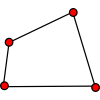
Flexi Quads
A quadrilateral changes shape with the edge lengths constant. Show the scalar product of the diagonals is constant. If the diagonals are perpendicular in one position are they always perpendicular?
Flexi Quad Tan
As a quadrilateral Q is deformed (keeping the edge lengths constnt) the diagonals and the angle X between them change. Prove that the area of Q is proportional to tanX.
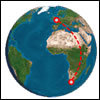
Air Routes
Find the distance of the shortest air route at an altitude of 6000 metres between London and Cape Town given the latitudes and longitudes. A simple application of scalar products of vectors.