Skip over navigation



Cross with the Scalar Product
Age 16 to 18
Challenge Level 

Why do this problem?
This problem helps to reinforce students' understanding of the vector and scalar product by encouraging them to think about how they are related geometrically.Possible approach
Perhaps begin with a recap of the scalar and vector product to
make sure students are clear about what each product is and how it
is calculated.
Then set the first challenge, to explore and describe
geometrically the set of vectors ${\bf u}$ with the property that
${\bf u}\cdot{\bf v}=0$. If students choose to consider the problem
algebraically, ask them to interpret their findings
geometrically.
Once students have reached their conclusions, introduce the
second part of the problem. Encourage students to consider how
their geometrical insights from the first part relate to what they
are being asked to do in the second part of the problem.
Identifying which of the four vectors could result from the cross
product of a vector with $\bf v$ should be straightforward and not
require lots of difficult algebra.
Finally, the problem asks students to find a method to quickly
construct other vectors which result from the cross product of
vectors with $\bf v$. Encourage students to think of how to
generate such vectors from vectors they have already found, using
the properties of the scalar product.
Key questions
What do the vectors $\bf u$ such that $\bf u \cdot \bf v =0$
have in common?
How can you consider this set of vectors $\bf u$
geometrically?
What do the vectors $\bf w$ resulting from the cross product
of $\bf v$ with other vectors have in common?
Possible extension
Find a method to quickly generate sets of vectors which are
perpendicular to $\pmatrix{a\cr b\cr c}$
Possible support
You may also like
Flexi Quads
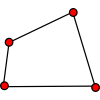
A quadrilateral changes shape with the edge lengths constant. Show the scalar product of the diagonals is constant. If the diagonals are perpendicular in one position are they always perpendicular?
Flexi Quad Tan
As a quadrilateral Q is deformed (keeping the edge lengths constnt) the diagonals and the angle X between them change. Prove that the area of Q is proportional to tanX.
Air Routes
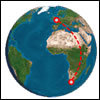
Find the distance of the shortest air route at an altitude of 6000 metres between London and Cape Town given the latitudes and longitudes. A simple application of scalar products of vectors.