Skip over navigation


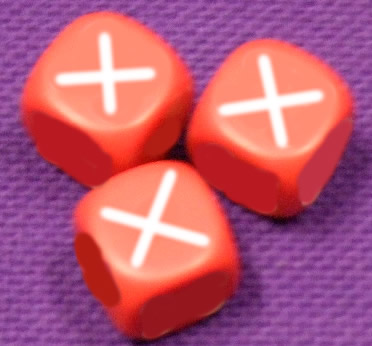 A new type of 6-sided die,
called an X-die, is proposed where instead of the faces being
numbered 1 to 6 as usual, the faces are numbered with positive
whole numbers such that their sum is 21. In this problem we will
say that a die $A$ is worse than a die $B$ if and only
if $P(A< B) > P(B< A)$ for a single throw. Conversely, a
die $A$ is better than a
die $B$ if and only if $P(A< B) < P(B< A)$ for a single
throw.
A new type of 6-sided die,
called an X-die, is proposed where instead of the faces being
numbered 1 to 6 as usual, the faces are numbered with positive
whole numbers such that their sum is 21. In this problem we will
say that a die $A$ is worse than a die $B$ if and only
if $P(A< B) > P(B< A)$ for a single throw. Conversely, a
die $A$ is better than a
die $B$ if and only if $P(A< B) < P(B< A)$ for a single
throw.
Can you create an X-die which is worse than an ordinary die?


X-dice
Age 16 to 18
Challenge Level 

A new type of 6-sided die,
called an X-die, is proposed where instead of the faces being
numbered 1 to 6 as usual, the faces are numbered with positive
whole numbers such that their sum is 21. In this problem we will
say that a die $A$ is worse than a die $B$ if and only
if $P(A< B) > P(B< A)$ for a single throw. Conversely, a
die $A$ is better than a
die $B$ if and only if $P(A< B) < P(B< A)$ for a single
throw.Can you create an X-die which is worse than an ordinary die?
Can you create an X-die which is better than an ordinary die
using only the numbers $1$ to $6$ (you don't have to use all of the
numbers!)?
Be clear in your explanations or reasoning.
You can prove your results using algebra or explore the
problem experimentally using a spreadsheet.
Extension: Explore the
notion of a 'worst' or a 'best' X-die.
You may also like
Rain or Shine
Predict future weather using the probability that tomorrow is wet given today is wet and the probability that tomorrow is wet given that today is dry.
Squash
If the score is 8-8 do I have more chance of winning if the winner is the first to reach 9 points or the first to reach 10 points?
Snooker
A player has probability 0.4 of winning a single game. What is his probability of winning a 'best of 15 games' tournament?