Skip over navigation


Draw the triangle pointing right such that the rightmost vertex is at $\mathbf{i}$
The coordinates of a regular $n$-gon with a centred on the origin with a vertex at $(1,0)$ are
$$\left(\cos\left(\frac{2m\pi}{n}\right), \sin\left(\frac{2m\pi}{n}\right)\right)\, \text{ where }m=0, \dots, n-1$$
For a pentagon, the coordinates become
$$
(1, 0), \left(\frac{1}{4}\left(\sqrt{5}-1\right), \frac{1}{4}\left(\sqrt{10+2\sqrt{5}}\right)\right), \left(-\frac{1}{4}\left(\sqrt{5}+1\right), \frac{1}{4}\left(\sqrt{10-2\sqrt{5}}\right)\right)
$$
along with the mirror images in the $x$-axis.
This problem builds on GCSE vector work and provides a foundation for concepts met in the later Core A Level modules.
Polygon Walk
Age 16 to 18
Challenge Level 

Draw the triangle pointing right such that the rightmost vertex is at $\mathbf{i}$
The coordinates of a regular $n$-gon with a centred on the origin with a vertex at $(1,0)$ are
$$\left(\cos\left(\frac{2m\pi}{n}\right), \sin\left(\frac{2m\pi}{n}\right)\right)\, \text{ where }m=0, \dots, n-1$$
For a pentagon, the coordinates become
$$
(1, 0), \left(\frac{1}{4}\left(\sqrt{5}-1\right), \frac{1}{4}\left(\sqrt{10+2\sqrt{5}}\right)\right), \left(-\frac{1}{4}\left(\sqrt{5}+1\right), \frac{1}{4}\left(\sqrt{10-2\sqrt{5}}\right)\right)
$$
along with the mirror images in the $x$-axis.
This problem builds on GCSE vector work and provides a foundation for concepts met in the later Core A Level modules.
You may also like
Schlafli Tessellations
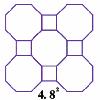
are somewhat mundane they do pose a demanding challenge in terms of 'elegant' LOGO procedures. This problem considers the eight semi-regular tessellations which pose a demanding challenge in terms of 'elegant' LOGO procedures.
Napoleon's Theorem
Triangle ABC has equilateral triangles drawn on its edges. Points P, Q and R are the centres of the equilateral triangles. What can you prove about the triangle PQR?