Skip over navigation
Cambridge University Faculty of Mathematics NRich logo
menu search
  • Teachers expand_more
    • Early years
    • Primary
    • Secondary
    • Post-16
    • Events
    • Professional development
  • Students expand_more
    • Primary
    • Secondary
    • Post-16
  • Parents expand_more
    • Early Years
    • Primary
    • Secondary
    • Post-16
  • Problem-Solving Schools
  • About NRICH expand_more
    • About us
    • Impact stories
    • Support us
    • Our funders
    • Contact us
  • search

Or search by topic

Number and algebra

  • The Number System and Place Value
  • Calculations and Numerical Methods
  • Fractions, Decimals, Percentages, Ratio and Proportion
  • Properties of Numbers
  • Patterns, Sequences and Structure
  • Algebraic expressions, equations and formulae
  • Coordinates, Functions and Graphs

Geometry and measure

  • Angles, Polygons, and Geometrical Proof
  • 3D Geometry, Shape and Space
  • Measuring and calculating with units
  • Transformations and constructions
  • Pythagoras and Trigonometry
  • Vectors and Matrices

Probability and statistics

  • Handling, Processing and Representing Data
  • Probability

Working mathematically

  • Thinking mathematically
  • Developing positive attitudes
  • Cross-curricular contexts

Advanced mathematics

  • Decision Mathematics and Combinatorics
  • Advanced Probability and Statistics
  • Mechanics
  • Calculus

For younger learners

  • Early Years Foundation Stage

Mixing Lemonade

Age 11 to 14
Challenge Level Yellow star
Secondary curriculum
  • Problem
  • Getting Started
  • Student Solutions
  • Teachers' Resources


Why do this problem?


This problem gives a clear context in which fractions, ratio and proportion can be investigated. When using the interactivity, students can develop strategies for comparing fractions or ratios while thinking about which strategies are most useful for different cases.
 

Possible approach

Start by showing the class the image of the two glasses of lemonade. Ask them to decide which would taste stronger, and then share different ways of working it out, collecting different representations on the board. Then use the interactivity to generate a couple more examples for the class to discuss in the same way.


If students have access to computers, set them to work in pairs using the interactivity, and challenge them to get ten correct answers in a row. A possible approach, if computers are unavailable, is to generate some questions and write them up on the board for students to work on with their partner. Alternatively, you could use the examples in this worksheet.


Once students have had a chance to develop clear strategies for working out which mixtures taste strongest, share with students the questions to consider from the problem and allow them some time to explore and discuss their answers.
 

Key questions

Is there a strategy that always works?
Is your strategy always the quickest way to work out which mixture tastes strongest?
 

Possible support

Spend plenty of time sharing alternative strategies for the first few simple examples on the worksheet, ensuring students understand why they work. Encourage students to work together using each other's methods to solve the harder examples.
 

Possible extension

The mediant of two fractions $\frac{a}{b}$ and $\frac{c}{d}$ is found by adding the numerators and the denominators: $\frac{a+c}{b+d}$


How could the lemonade problem be used to convince someone that the mediant is always in between the two original fractions?


Ratios and Dilutions looks at solution strength at a more challenging level.


You may also like

Tweedle Dum and Tweedle Dee

Two brothers were left some money, amounting to an exact number of pounds, to divide between them. DEE undertook the division. "But your heap is larger than mine!" cried DUM...

Sum Equals Product

The sum of the numbers 4 and 1 [1/3] is the same as the product of 4 and 1 [1/3]; that is to say 4 + 1 [1/3] = 4 � 1 [1/3]. What other numbers have the sum equal to the product and can this be so for any whole numbers?
Special Sums and Products

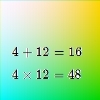
Find some examples of pairs of numbers such that their sum is a factor of their product. eg. 4 + 12 = 16 and 4 × 12 = 48 and 16 is a factor of 48.

  • Tech help
  • Accessibility Statement
  • Sign up to our newsletter
  • Twitter X logo

The NRICH Project aims to enrich the mathematical experiences of all learners. To support this aim, members of the NRICH team work in a wide range of capacities, including providing professional development for teachers wishing to embed rich mathematical tasks into everyday classroom practice.

NRICH is part of the family of activities in the Millennium Mathematics Project.

University of Cambridge logo NRICH logo