Skip over navigation
Cambridge University Faculty of Mathematics NRich logo
menu search
  • Teachers expand_more
    • Early years
    • Primary
    • Secondary
    • Post-16
    • Events
    • Professional development
  • Students expand_more
    • Primary
    • Secondary
    • Post-16
  • Parents expand_more
    • Early Years
    • Primary
    • Secondary
    • Post-16
  • Problem-Solving Schools
  • About NRICH expand_more
    • About us
    • Impact stories
    • Support us
    • Our funders
    • Contact us
  • search

Or search by topic

Number and algebra

  • The Number System and Place Value
  • Calculations and Numerical Methods
  • Fractions, Decimals, Percentages, Ratio and Proportion
  • Properties of Numbers
  • Patterns, Sequences and Structure
  • Algebraic expressions, equations and formulae
  • Coordinates, Functions and Graphs

Geometry and measure

  • Angles, Polygons, and Geometrical Proof
  • 3D Geometry, Shape and Space
  • Measuring and calculating with units
  • Transformations and constructions
  • Pythagoras and Trigonometry
  • Vectors and Matrices

Probability and statistics

  • Handling, Processing and Representing Data
  • Probability

Working mathematically

  • Thinking mathematically
  • Developing positive attitudes
  • Cross-curricular contexts

Advanced mathematics

  • Decision Mathematics and Combinatorics
  • Advanced Probability and Statistics
  • Mechanics
  • Calculus

For younger learners

  • Early Years Foundation Stage

Sort Them Out (1)

Age 5 to 7
Challenge Level Yellow star
Primary curriculum
  • Problem
  • Getting Started
  • Student Solutions
  • Teachers' Resources

Sort Them Out (1)

Sort Them Out (1) printable sheet
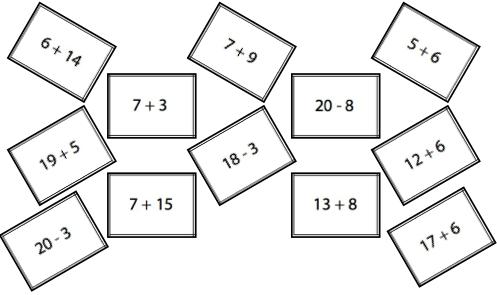


It's best to do this with $3$ other friends.
Share all the cards out equally among the four of you.

Work out what the answer is to each question on your cards.
Do you notice anything?
What do you notice?
Try sorting or arranging the cards in some way.


Why do this problem?

The intention of this problem is that children will work together as a team. It should help in developing mathematical language as well as providing interesting practice in addition and subtraction and possibly offer opportunities to share calculation strategies. It gives ample opportunities to practise calculations using numbers to $20$ and should support children to remember these facts so that they are able to recall and use them whenever they need to do so.

Possible approach

The sheet of cards will need to be printed out. Give out a set of cards to each group of four to six children - it is important to give out all the cards in the set! (The questions asked in the set do vary in difficulty so you may like to choose who to give specific cards to.) To begin with, give children time to work individually on the questions on their own cards. After a suitable period of time, encourage them to ask each other about the questions and answers on other cards. At this stage, members of the group can help each other with the questions, but discourage them from simply giving someone else an answer.

Challenge each group to organise or arrange the cards in some way. At this point, stand back and try not to intervene as they work together. You could invite them to display their cards in their chosen arrangement and then give some time for everyone to move around the room to look at the way each group has sorted the cards.
 
A short plenary should provide an opportunity for the groups to explain the organisation they chose and for such remarks as "I knew my answer was wrong because it didn't fit in with anyone else's".

Key questions

Tell me about the number you have found.
Have you asked the others in your group about the numbers they have found?
Did you notice anything?
Are you sure that answer is right? How could you check it?
Can you think of a way of arranging the cards?

Possible extension

Learners who find these questions easy may not have solved the problem! How can the cards be organised, arranged or ordered? Such children could help other members of the team check all the answers. Some learners may want to devise their own set of cards to be used in a similar way.
 
However, it may be more suitable for some groups of children to try this similar, but harder, version of the problem.


Possible support

You can purposely give certain cards to certain children if you do not want to take them too far out of their comfort zone where calculation is concerned. It may be appropriate for some learners to share cards with someone who is slightly more confident with addition and subtraction than they are themselves. Encourage them both to feel responsible for their findings and ensure everyone is involved in the class discussion.
 

You may also like
Three Squares

What is the greatest number of squares you can make by overlapping three squares?

Two Dice

Find all the numbers that can be made by adding the dots on two dice.

Biscuit Decorations

Andrew decorated 20 biscuits to take to a party. He lined them up and put icing on every second biscuit and different decorations on other biscuits. How many biscuits weren't decorated?

  • Tech help
  • Accessibility Statement
  • Sign up to our newsletter
  • Twitter X logo

The NRICH Project aims to enrich the mathematical experiences of all learners. To support this aim, members of the NRICH team work in a wide range of capacities, including providing professional development for teachers wishing to embed rich mathematical tasks into everyday classroom practice.

NRICH is part of the family of activities in the Millennium Mathematics Project.

University of Cambridge logo NRICH logo