Skip over navigation


Mum and her four children live with Gran at 13 Drywater Street.
One day, Charlie, who is the third child, asked, "Gran, how old are you?"
Gran answered, "My Grandmother would have said 'As old as my tongue and a little older than my teeth!' but I will tell you how to work out my age."
"If you multiply Mum's age with your age and with the ages of your brother and sisters you will get the answer $111 111$.
If you add Mum's age along with the ages of all you four children the total will be my age."
Charlie worked this out very quickly, because he knew his Mum's age, his age and the ages of his brother and sisters.
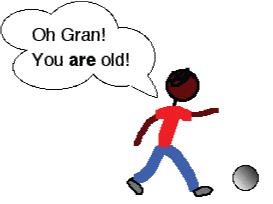
"Oh Gran!" he called as he ran off to play outside, "You are old!"
How old was his Gran?
Gran, How Old Are You?
Age 7 to 11
Challenge Level 

Gran, How Old Are You?
Mum and her four children live with Gran at 13 Drywater Street.
One day, Charlie, who is the third child, asked, "Gran, how old are you?"
Gran answered, "My Grandmother would have said 'As old as my tongue and a little older than my teeth!' but I will tell you how to work out my age."
"If you multiply Mum's age with your age and with the ages of your brother and sisters you will get the answer $111 111$.
If you add Mum's age along with the ages of all you four children the total will be my age."
Charlie worked this out very quickly, because he knew his Mum's age, his age and the ages of his brother and sisters.
"Oh Gran!" he called as he ran off to play outside, "You are old!"
How old was his Gran?
Why do this problem?
This problem involves unknowns, and encourages algebraic thinking, but does not rely on using letters to represent the unknowns. Instead, it encourages multiple approaches, so learners might use trial and improvement, for example. It is an ideal opportunity to reinforce the idea that there isn't just one way to solve a problem, although some methods might end up being more efficient than others (for most people). This challenge also consolidates understanding of multiplication and division being inverses of each other, and it might offer a chance to discuss divisibility rules.Possible approach
Introduce the problem to the class as it stands, perhaps orally, or by projecting the page onto the whiteboard. Give everyone time to think about how they might approach it in pairs or small groups, being very careful not to say anything else at all. This may feel very uncomfortable for some children (and for you!) but try not to help them at this stage.
After a suitable length of time, bring everyone together and invite comments on how the problem might be tackled. Once again, try not to advocate one method but once several ways have been discussed, explain that you will give more time for working on the solution now. Each group can choose how they go about the problem so they could use a method that someone else has suggested.
After more time, you could bring the whole class together again to talk about progress so far. Then allow a period of time for further work on the solution and perhaps also for each pair/group to summarise their method/s on a poster, including reflection on how well their method/s worked.
The last part of the lesson could be used for groups to look at each other's posters and compare solutions. This could lead into a discussion about the advantages and disadvantages of each method.
Key questions
What information do you know?
How could you use this to try and find a solution?
What could you try first?
How old do you think Charlie's mother could be?
How old do you think Charlie could be?
Possible extension
Learners could find numbers with interesting factors and make up their own similar problem. Does their own problem have a unique solution? How do they know?Possible support
Some children may find a calculator useful.You may also like
Guess the Dominoes
This task depends on learners sharing reasoning, listening to opinions, reflecting and pulling ideas together.
Factor Track
Factor track is not a race but a game of skill. The idea is to go round the track in as few moves as possible, keeping to the rules.