Skip over navigation


Answer: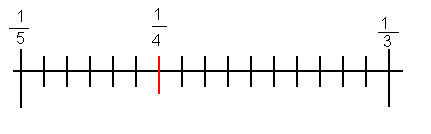
Using a common denominator
$$\frac15 \qquad \frac14 \qquad \frac13\\
\\
\frac{12}{60} \qquad \frac{15}{60} \qquad \frac{20}{60}$$ The distance from $\dfrac{12}{60}$ to $\dfrac{20}{60}$ is $\dfrac 8{60}$
There are $16$ intervals on the diagram so two make $\dfrac1{60}$
The distance from $\dfrac{12}{60}$ to $\dfrac{15}{60}$ is $\dfrac 3{60}$ so go along $6$ intervals
Finding the size of the intervals
The difference between $\frac{1}{3}$ and $\frac{1}{5}$ is $\frac{1}{3}-\frac{1}{5}= \frac{2}{15}$.
This section of the number line is divided into $16$ intervals, each of length $\frac{2}{15}\div 16 = \frac{1}{120}$.
The difference between $\frac{1}{4}$ and $\frac{1}{5}$ is $\frac{1}{4}-\frac{1}{5}= \frac{1}{20}= \frac{6}{120}$, and hence $\frac{1}{4}$is six smaller intervals from $\frac{1}{5}$.


Pride of Place
Age 11 to 14
ShortChallenge Level 

Answer:
Using a common denominator
$$\frac15 \qquad \frac14 \qquad \frac13\\
\\
\frac{12}{60} \qquad \frac{15}{60} \qquad \frac{20}{60}$$ The distance from $\dfrac{12}{60}$ to $\dfrac{20}{60}$ is $\dfrac 8{60}$
There are $16$ intervals on the diagram so two make $\dfrac1{60}$
The distance from $\dfrac{12}{60}$ to $\dfrac{15}{60}$ is $\dfrac 3{60}$ so go along $6$ intervals
Finding the size of the intervals
The difference between $\frac{1}{3}$ and $\frac{1}{5}$ is $\frac{1}{3}-\frac{1}{5}= \frac{2}{15}$.
This section of the number line is divided into $16$ intervals, each of length $\frac{2}{15}\div 16 = \frac{1}{120}$.
The difference between $\frac{1}{4}$ and $\frac{1}{5}$ is $\frac{1}{4}-\frac{1}{5}= \frac{1}{20}= \frac{6}{120}$, and hence $\frac{1}{4}$is six smaller intervals from $\frac{1}{5}$.
This problem is taken from the UKMT Mathematical Challenges.
You can find more short problems, arranged by curriculum topic, in our short problems collection.
You may also like
Consecutive Numbers
An investigation involving adding and subtracting sets of consecutive numbers. Lots to find out, lots to explore.
Days and Dates
Investigate how you can work out what day of the week your birthday will be on next year, and the year after...