Skip over navigation


This problem follows on from Troublesome Dice.
Jenny and her family often roll a die to decide who gets to eat the last slice of pie, but when they roll it, the die often seems to land "edge-up" or "corner-up" on a napkin, so they roll again.
One day, Jenny suggests that instead of rolling again, when the die lands corner-up or edge-up, they simply add the visible faces together:
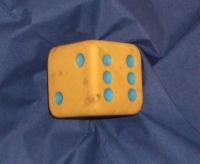
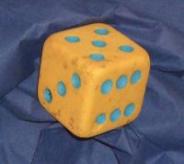
What assumptions would you need to make to come up with a fair way of determining who gets the last slice of pie?
Here are some questions you might like to consider:
Suppose the die lands face-up with probability $\frac {1}{2}$, edge-up with probability $\frac{1}{3}$ and corner-up with probability $\frac{1}{6}$. How could you allocate totals to three people to give each of them an equal chance of getting the last slice of pie?
Suppose the die lands face-up with probability $p$, edge-up with probability $q$, and corner-up with probability $r = 1-(p+q)$. Are there any family sizes for which you can always allocate totals fairly, regardless of the values of $p$, $q$ and $r$?
The relative frequency of face-up, edge-up and corner-up scores for the standard 6-sided die are distributed symmetrically. Can you explain why?
This problem is based on an idea shared by Paul Stephenson.



Dicey Decisions
Age 16 to 18
Challenge Level 

This problem follows on from Troublesome Dice.
Jenny and her family often roll a die to decide who gets to eat the last slice of pie, but when they roll it, the die often seems to land "edge-up" or "corner-up" on a napkin, so they roll again.
One day, Jenny suggests that instead of rolling again, when the die lands corner-up or edge-up, they simply add the visible faces together:
What assumptions would you need to make to come up with a fair way of determining who gets the last slice of pie?
Here are some questions you might like to consider:
Suppose the die lands face-up with probability $\frac {1}{2}$, edge-up with probability $\frac{1}{3}$ and corner-up with probability $\frac{1}{6}$. How could you allocate totals to three people to give each of them an equal chance of getting the last slice of pie?
Suppose the die lands face-up with probability $p$, edge-up with probability $q$, and corner-up with probability $r = 1-(p+q)$. Are there any family sizes for which you can always allocate totals fairly, regardless of the values of $p$, $q$ and $r$?
The relative frequency of face-up, edge-up and corner-up scores for the standard 6-sided die are distributed symmetrically. Can you explain why?
This problem is based on an idea shared by Paul Stephenson.
You may also like
Knock-out
Before a knockout tournament with 2^n players I pick two players. What is the probability that they have to play against each other at some point in the tournament?
Squash
If the score is 8-8 do I have more chance of winning if the winner is the first to reach 9 points or the first to reach 10 points?
Snooker
A player has probability 0.4 of winning a single game. What is his probability of winning a 'best of 15 games' tournament?