Skip over navigation
Cambridge University Faculty of Mathematics NRich logo
menu search
  • Teachers expand_more
    • Early years
    • Primary
    • Secondary
    • Post-16
    • Events
    • Professional development
  • Students expand_more
    • Primary
    • Secondary
    • Post-16
  • Parents expand_more
    • Early Years
    • Primary
    • Secondary
    • Post-16
  • Problem-Solving Schools
  • About NRICH expand_more
    • About us
    • Impact stories
    • Support us
    • Our funders
    • Contact us
  • search

Or search by topic

Number and algebra

  • The Number System and Place Value
  • Calculations and Numerical Methods
  • Fractions, Decimals, Percentages, Ratio and Proportion
  • Properties of Numbers
  • Patterns, Sequences and Structure
  • Algebraic expressions, equations and formulae
  • Coordinates, Functions and Graphs

Geometry and measure

  • Angles, Polygons, and Geometrical Proof
  • 3D Geometry, Shape and Space
  • Measuring and calculating with units
  • Transformations and constructions
  • Pythagoras and Trigonometry
  • Vectors and Matrices

Probability and statistics

  • Handling, Processing and Representing Data
  • Probability

Working mathematically

  • Thinking mathematically
  • Developing positive attitudes
  • Cross-curricular contexts

Advanced mathematics

  • Decision Mathematics and Combinatorics
  • Advanced Probability and Statistics
  • Mechanics
  • Calculus

For younger learners

  • Early Years Foundation Stage

Fill Me up Too

Age 14 to 16
Challenge Level Yellow starYellow star
Secondary curriculum
  • Problem
  • Getting Started
  • Student Solutions
  • Teachers' Resources


Why do this problem?

This problem follows on from Fill Me Up, and gives students the opportunity to use volume scale factors of enlargement to work out the relationship between the volume and the height of a cone.

Possible approach

Perhaps start by asking students to sketch the graphs from the problem Fill Me Up. Here is a worksheet showing the containers.

 
"Imagine we wanted to plot the graphs accurately by working out the equations linking height to volume. Some parts of the containers will be easier to work out than others - which will be easiest? Which will be hardest?"
 
Take time to discuss students' ideas, relating it back to the graphs sketched in the first problem.
 
"Let's try to analyse how the height changes as the Pint Glass is filled." 
"The Pint Glass can be thought of as part of a cone (a frustum), so I'd like you to consider a cone filling with water first."
Give students this worksheet to work on in groups of 3 or 4. These roles may be useful for students who are not used to working collaboratively on a problem. Make it clear that your expectation is for all students in the group to be able to explain their thinking clearly and that anyone might be chosen to present the group's conclusions at the end of the lesson.
 
Finally, allow time at the end of the lesson (or two lessons) for groups to present their thinking to the rest of the class. 


Key questions

What happens to the volume of a cone when I enlarge it by a scale factor of 2, 3, 4, 5... k?

If the volume of water is $10$cm$^3$ when the height of the water is $1$cm, what will the volume be when the height is $2, 3, 4...x$cm?
How could this be represented graphically?
 

Possible support

Growing Rectangles offers a good introduction to proportional relationships between length, area and volume.
 

Possible extension

There are two extension tasks suggested in the problem: analysing the inverted cone is a reasonably straightforward extension, but analysing the spherical flask is much much more challenging.
 
Immersion and Brimful both offer extension possibilities for considering functional relationships relating to volume.


You may also like
Ball Packing

If a ball is rolled into the corner of a room how far is its centre from the corner?

Three Balls

A circle has centre O and angle POR = angle QOR. Construct tangents at P and Q meeting at T. Draw a circle with diameter OT. Do P and Q lie inside, or on, or outside this circle?
In a Spin

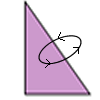
What is the volume of the solid formed by rotating this right angled triangle about the hypotenuse?

  • Tech help
  • Accessibility Statement
  • Sign up to our newsletter
  • Twitter X logo

The NRICH Project aims to enrich the mathematical experiences of all learners. To support this aim, members of the NRICH team work in a wide range of capacities, including providing professional development for teachers wishing to embed rich mathematical tasks into everyday classroom practice.

NRICH is part of the family of activities in the Millennium Mathematics Project.

University of Cambridge logo NRICH logo