Skip over navigation
Cambridge University Faculty of Mathematics NRich logo
menu search
  • Teachers expand_more
    • Early years
    • Primary
    • Secondary
    • Post-16
    • Events
    • Professional development
  • Students expand_more
    • Primary
    • Secondary
    • Post-16
  • Parents expand_more
    • Early Years
    • Primary
    • Secondary
    • Post-16
  • Problem-Solving Schools
  • About NRICH expand_more
    • About us
    • Impact stories
    • Support us
    • Our funders
    • Contact us
  • search

Or search by topic

Number and algebra

  • The Number System and Place Value
  • Calculations and Numerical Methods
  • Fractions, Decimals, Percentages, Ratio and Proportion
  • Properties of Numbers
  • Patterns, Sequences and Structure
  • Algebraic expressions, equations and formulae
  • Coordinates, Functions and Graphs

Geometry and measure

  • Angles, Polygons, and Geometrical Proof
  • 3D Geometry, Shape and Space
  • Measuring and calculating with units
  • Transformations and constructions
  • Pythagoras and Trigonometry
  • Vectors and Matrices

Probability and statistics

  • Handling, Processing and Representing Data
  • Probability

Working mathematically

  • Thinking mathematically
  • Developing positive attitudes
  • Cross-curricular contexts

Advanced mathematics

  • Decision Mathematics and Combinatorics
  • Advanced Probability and Statistics
  • Mechanics
  • Calculus

For younger learners

  • Early Years Foundation Stage

Some Secret Codes

Age 7 to 11
Challenge Level Yellow starYellow starYellow star
  • Problem
  • Getting Started
  • Student Solutions
  • Teachers' Resources

Some Secret Codes


Here is the alphabet:

a  b  c  d  e  f  g  h  i  j  k  l  m  n  o  p  q  r  s  t  u  v  w  x  y  z


I have made a code that means we move $3$ places to the left to discover what the code stands for. But what will happen to

a b c ?

They pick up the letters left over at the end of the alphabet so that they become

x  y z  
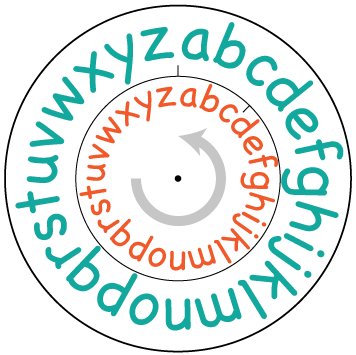
You can think of the letters as if they were arranged on a wheel like this:
A coding wheel
 Print out and make
 
So can you work out what these codes stand for?
 

sdw - d - fdnh,

wkh - zhvw - zlqg - eorzv,

brx - duh - zrunlqj - kdug


Can you invent some messages of your own?

Can you create some different ways of coding?


Why do this problem?

This activity enables pupils to use some simple counting in addition and subtraction situations. It also starts pupils thinking about codes and the fun that can be had with them. Here is a link to a short article from Jenny Murray about how she developed her interest in coding.

Possible approach

The activity can be started off as a game in which the teacher says something about some secret ideas/thoughts they are having when looking at the alphabet. So, with the alphabet displayed as separate cards in order in front of the pupils they say they want to spell out (eg dog) but the teacher carefully goes for g r j instead of d o g.This will obviously lead to some discussion. Perhaps other examples will be needed until the "rule" is established.

Key questions

What do you think has happened?
What letters will you choose?
I see you've made your own code, can you tell me about it?

Possible extension

Have a look at this as an extension

Possible support

Some children will need the alphabet individually in front of them.


You may also like

Numbered Cars

I was looking at the number plate of a car parked outside. Using my special code S208VBJ adds to 65. Can you crack my code and use it to find out what both of these number plates add up to?
Unlocking the Case

A case is found with a combination lock. There is one clue about the number needed to open the case. Can you find the number and open the case?
James's Code Challenge

The Enigma Project's James Grime has created a video code challenge. Watch it here!

  • Tech help
  • Accessibility Statement
  • Sign up to our newsletter
  • Twitter X logo

The NRICH Project aims to enrich the mathematical experiences of all learners. To support this aim, members of the NRICH team work in a wide range of capacities, including providing professional development for teachers wishing to embed rich mathematical tasks into everyday classroom practice.

NRICH is part of the family of activities in the Millennium Mathematics Project.

University of Cambridge logo NRICH logo