

Can They Be Equal? Poster


Using whole numbers only: 3 by 6 and 4 by 4
Using fractions: Any two numbers $a$ and $b$ where $a\gt2$ and $b = \frac{2a}{a-2}$
Why?
Geometrically
 Each square along the edges accounts for one unit of perimeter, except for the four corner squares. They account for two units of perimeter but only one unit of area. This means the perimeter is 4 more than the area. There will have to be 4 squares in the middle that will only be
counted for the area and not the perimeter.
Each square along the edges accounts for one unit of perimeter, except for the four corner squares. They account for two units of perimeter but only one unit of area. This means the perimeter is 4 more than the area. There will have to be 4 squares in the middle that will only be
counted for the area and not the perimeter.
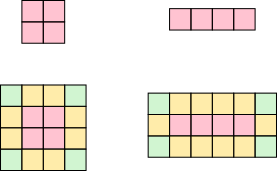
There are only two ways to make a rectangle using 4 squares.
These make 4 by 4 or 3 by 6 rectangles.
This extends to fractions if the sides of the red rectangle aren't whole numbers, but any two numbers which multiply to 4.
Algebraically
Sides $a$ and $b$
Perimeter: $2a+2b$
Area: $ab$
$2a+2b = ab$
Factorising to get whole number solutions:
$ab - 2a-2b = 0$
$(a-2)(b-2) = \underbrace{ab-2a-2b}_0+4 \therefore (a-2)(b-2)=4$
(This fits with the geometry above because the sides of the red rectangle are $a-2$ and $b-2$)
Whole number solutions: $a-2$ and $b-2$ are $1$ and $3$ or $2$ and $2$
$\therefore a$ and $b$ are $3$ and $6$ or $4$ and $4$
Other solutions: Find any two numbers which multiply to give $4$ and add $2$ to each of them
Rearranging to get infinitely many solutions
$\begin{align}ab-2b &= 2a\\
\Rightarrow b(a-2)&=2a\\
\Rightarrow b&=\frac{2a}{a-2}\end{align}$
$a$ and $b$ need to be positive $\therefore a\gt2.$ Infinitely many solutions.
Related Collections
You may also like

Consecutive Numbers
An investigation involving adding and subtracting sets of consecutive numbers. Lots to find out, lots to explore.

Days and Dates
Investigate how you can work out what day of the week your birthday will be on next year, and the year after...