Skip over navigation
Cambridge University Faculty of Mathematics NRich logo
menu search
  • Teachers expand_more
    • Early years
    • Primary
    • Secondary
    • Post-16
    • Events
    • Professional development
  • Students expand_more
    • Primary
    • Secondary
    • Post-16
  • Parents expand_more
    • Early Years
    • Primary
    • Secondary
    • Post-16
  • Problem-Solving Schools
  • About NRICH expand_more
    • About us
    • Impact stories
    • Support us
    • Our funders
    • Contact us
  • search

Or search by topic

Number and algebra

  • The Number System and Place Value
  • Calculations and Numerical Methods
  • Fractions, Decimals, Percentages, Ratio and Proportion
  • Properties of Numbers
  • Patterns, Sequences and Structure
  • Algebraic expressions, equations and formulae
  • Coordinates, Functions and Graphs

Geometry and measure

  • Angles, Polygons, and Geometrical Proof
  • 3D Geometry, Shape and Space
  • Measuring and calculating with units
  • Transformations and constructions
  • Pythagoras and Trigonometry
  • Vectors and Matrices

Probability and statistics

  • Handling, Processing and Representing Data
  • Probability

Working mathematically

  • Thinking mathematically
  • Developing positive attitudes
  • Cross-curricular contexts

Advanced mathematics

  • Decision Mathematics and Combinatorics
  • Advanced Probability and Statistics
  • Mechanics
  • Calculus

For younger learners

  • Early Years Foundation Stage

Round and Round the Circle

Age 7 to 11
Challenge Level Yellow starYellow star
Primary curriculum
  • Problem
  • Getting Started
  • Student Solutions
  • Teachers' Resources

Round and Round the Circle


I started with a clock without hands or the minute divisions (except for those where there is a number). The $12$ was replaced by a $0$ and the numbers placed outside the face.


I ruled lines joining up the numbers.

I started by counting in ones and I got a $12$-gon (that is a $12$-sided polygon - if you like long words you can call it a dodecagon).


Then I ruled lines counting round in $2$s. And I got .....?


Perhaps you do not need to put the numbers round the circles.

I tried $5$s (wow!) and $6$s (well!).

Each time I go on drawing lines until I get to the point where I first started.

Then I tried $7$s, $8$s, $9$s, $10$s, and $11$s.

Something interesting was happening.

Why don't you try it? What patterns do you notice emerging?

And what about counting round in $12$s?

Which shapes are the same? Can you think of a reason why?

Can you see a connection between the number in which you are counting around the circle and the number of sides in the shape you are making?


Why do this problem?

This problem brings out patterns in numbers, factors and multiples as well as properties of shapes. There are plenty of opportunities for visualising to predict what patterns will emerge. Learners will need to work systematically and to generalise, and the work done also often makes a very appealing 'finished product' for display purposes.

Possible approach

You could start with a clock with the numbers round the outside of the circle, but change the $12$ into a $0$ as in the question. If you are able to display the image on an interactive whiteboard, you will be able to draw round in ones and then start the twos (as in the question). Ask the group to predict what will happen, and then to check by continuing to draw on the board. Make sure that they understand that they go on round the circle until they reach $0$ again.

Many children have a problem with counting round in $5$s. To avoid this show them how it is done on the board. Start at $0$ count round $5$ and make a mark by the relevant place on the circle. Now join the $0$ to this mark. Again, count round $5$ and make a mark by the relevant place on the circle and join this to the place where the last line finished. Continue doing this until you reach $0$ again. You should have visited every point round the circle by this time.

Children can then work on the challenge in pairs - encourage them to make predictions before testing them. Make sure that they realise that every number should be done on a new dial. This sheet of six numbered circles, which makes a good starting point, can be printed out. Alternatively, this sheet has twelve copies of the $12$-circle.

After a suitable length of time, draw learners together to share their findings. You may want to collate their results on the board as pairs demonstrate the drawing or show their sketches. Ask them to explain how the shapes relate to the number of divisions round the circles, looking out for those who use appropriate vocabulary such as 'factor' and 'multiple'. Which numbers produced the same shapes? Ask again about the relationship of these to the number of divisions round the circles. Press the group to generalise their findings as this can bring out interesting facts about factors, multiples and primes. You might find this interactivity helpful in the discussion.

(If you want to make mathematical stars for Christmas or Divali make sheets with circles divided into a prime number of divisions such as $5$, $7$, $11$ and $13$.)

Key questions

Have you made this shape before? Which number made it?
Can you see a connection between these two numbers and the number of divisions round the circle?
Can you predict what different shapes you will get with this circle?
What is the connection between these two numbers?
Which numbers make stars? Why?

Possible extension

After doing the $12$s and $10$s, learners could try to predict which shapes will be produced with other numbers on the circle before testing their predictions. This sheet has three copies each of circles marked in $10$s, $9$s, $8$s and $7$s. You might be able to introduce the concept of 'co-prime'.

Possible support

Most difficulties with this problem (at the start at least) lie in the actual drawing rather than in the numbers. Encourage learners to pencil very lightly so the work can be rubbed out if necessary and to mark where they are going before starting to draw the line. Pupils often have trouble with counting round in $5$s so it might help to go through the process, stage by stage: start at $0$, count round $5$ and make a mark by the relevant place on the circle. Now join the $0$ to this mark. Again, count round $5$ and make a mark by the relevant place on the circle and join this to the place where the last line finished. Continue doing this until $0$ is reached again. Every point round the circle should have been visited by this time.


You may also like

Doplication

We can arrange dots in a similar way to the 5 on a dice and they usually sit quite well into a rectangular shape. How many altogether in this 3 by 5? What happens for other sizes?
Making Cuboids

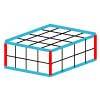
Let's say you can only use two different lengths - 2 units and 4 units. Using just these 2 lengths as the edges how many different cuboids can you make?
Quadrilaterals

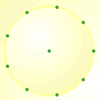
How many DIFFERENT quadrilaterals can be made by joining the dots on the 8-point circle?

  • Tech help
  • Accessibility Statement
  • Sign up to our newsletter
  • Twitter X logo

The NRICH Project aims to enrich the mathematical experiences of all learners. To support this aim, members of the NRICH team work in a wide range of capacities, including providing professional development for teachers wishing to embed rich mathematical tasks into everyday classroom practice.

NRICH is part of the family of activities in the Millennium Mathematics Project.

University of Cambridge logo NRICH logo