Skip over navigation

Cambridge University Faculty of Mathematics NRich logo
menu search
  • Teachers expand_more
    • Early years
    • Primary
    • Secondary
    • Post-16
    • Events
    • Professional development
  • Students expand_more
    • Primary
    • Secondary
    • Post-16
  • Parents expand_more
    • Early Years
    • Primary
    • Secondary
    • Post-16
  • Problem-Solving Schools
  • About NRICH expand_more
    • About us
    • Impact stories
    • Support us
    • Our funders
    • Contact us
  • search

Or search by topic

Number and algebra

  • The Number System and Place Value
  • Calculations and Numerical Methods
  • Fractions, Decimals, Percentages, Ratio and Proportion
  • Properties of Numbers
  • Patterns, Sequences and Structure
  • Algebraic expressions, equations and formulae
  • Coordinates, Functions and Graphs

Geometry and measure

  • Angles, Polygons, and Geometrical Proof
  • 3D Geometry, Shape and Space
  • Measuring and calculating with units
  • Transformations and constructions
  • Pythagoras and Trigonometry
  • Vectors and Matrices

Probability and statistics

  • Handling, Processing and Representing Data
  • Probability

Working mathematically

  • Thinking mathematically
  • Developing positive attitudes
  • Cross-curricular contexts

Advanced mathematics

  • Decision Mathematics and Combinatorics
  • Advanced Probability and Statistics
  • Mechanics
  • Calculus

For younger learners

  • Early Years Foundation Stage

What Number?

Age 5 to 7
ShortChallenge Level Yellow starYellow star
  • Problem
  • Getting Started
  • Solutions
  • Teachers' Resources

What Number?


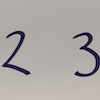
I am less than 25.

My ones digit is twice my tens digit.

My digits add up to an even number.

What am I?


Why do this problem?

This is a quick problem suitable for starting a lesson and requiring no resources. It can usefully be made into a longer activity by focussing discussion on the possible problem-solving strategies and evaluating them.

Possible approach

Offer the children time to work in pairs and record their thinking on large pieces of paper. Pin them up centrally and encourage the children to look for similarities and differences in the way the problem has been solved. Do they think one way is better than the others, and if so why?

You could make it a more structured discussion by writing the three pieces of information (less than $25$, ones double tens, add to even number) on three pieces of paper and ordering them differently, in each case writing down the possible numbers from the first piece of information and eliminating those that don't fit the second and the third. Do the children think one order was better than the others?

Key questions

What do you know?
Can you make a list?

Possible extension

Children can make up similar questions for each other. Can they use three digits? Can they be sure there is only one answer to their question?

Possible support

Working in pairs to record thought processes can be very threatening for children who find such questions difficult. You could instead perhaps give them cards with numbers up to $25$ and they could remove the ones that didn't fit the other two conditions.


Related Collections

You may also like

Writing Digits

Lee was writing all the counting numbers from 1 to 20. She stopped for a rest after writing seventeen digits. What was the last number she wrote?


Number Detective

Follow the clues to find the mystery number.

Palindromes

Find out about palindromic numbers by reading this article.

  • Tech help
  • Accessibility Statement
  • Sign up to our newsletter
  • Twitter X logo

The NRICH Project aims to enrich the mathematical experiences of all learners. To support this aim, members of the NRICH team work in a wide range of capacities, including providing professional development for teachers wishing to embed rich mathematical tasks into everyday classroom practice.

NRICH is part of the family of activities in the Millennium Mathematics Project.

University of Cambridge logo NRICH logo