Skip over navigation


Tom and Ben are in Numberland in the district called Addition.
They have a map which looks like this:
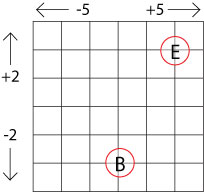
They are at point B and they begin their journey with ten points.
For every square they walk to the right on the map, they add five.
For every square they walk to the left on the map, they take away five.
If they go North (up on the map), they add two for every square, and if they go South (down on the map), they take away two for every square.
First they make these journeys:
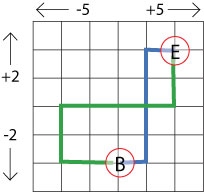
The blue line shows Tom's journey and the green line shows Ben's.
How many points do they have each when they reach E?
Do you notice anything?
Here is a different grid for you to make up some journeys of your own, beginning at B and ending at E.
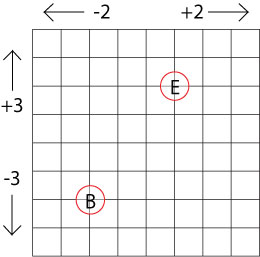
You can download and print off this sheet which has two copies of the grid map.
After they had explored in the district called Addition in Numberland, Tom and Ben go on to the district called Multiply.
Here they have a new map which looks like this (here are two copies of the map):
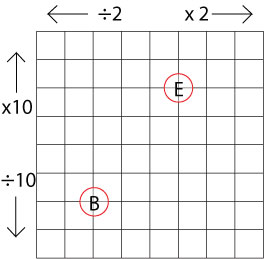
They explore here too. Each time they start at B with $10$ points and make their way to E. Try lots of journeys yourself.
What do you notice about the journeys this time?
Can you explain why this happens?


Journeying in Numberland
Age 7 to 11
Challenge Level 

Tom and Ben are in Numberland in the district called Addition.
They have a map which looks like this:
They are at point B and they begin their journey with ten points.
For every square they walk to the right on the map, they add five.
For every square they walk to the left on the map, they take away five.
If they go North (up on the map), they add two for every square, and if they go South (down on the map), they take away two for every square.
First they make these journeys:
The blue line shows Tom's journey and the green line shows Ben's.
How many points do they have each when they reach E?
Do you notice anything?
Here is a different grid for you to make up some journeys of your own, beginning at B and ending at E.
You can download and print off this sheet which has two copies of the grid map.
What do you notice about your different journeys?
Can you explain your observations?
After they had explored in the district called Addition in Numberland, Tom and Ben go on to the district called Multiply.
Here they have a new map which looks like this (here are two copies of the map):
They explore here too. Each time they start at B with $10$ points and make their way to E. Try lots of journeys yourself.
What do you notice about the journeys this time?
Can you explain why this happens?
You may also like
Counting Counters
Take a counter and surround it by a ring of other counters that MUST touch two others. How many are needed?
Cuisenaire Squares
These squares have been made from Cuisenaire rods. Can you describe the pattern? What would the next square look like?
Doplication
We can arrange dots in a similar way to the 5 on a dice and they usually sit quite well into a rectangular shape. How many altogether in this 3 by 5? What happens for other sizes?