

Cuboids

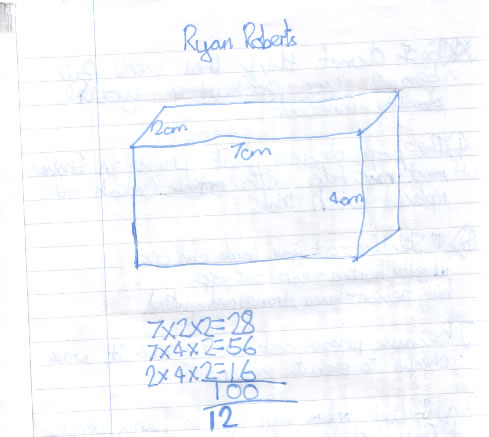
Justin from Mason Middle School found that a 1x2x16 cuboid also satisfies the conditions:
I back it up by saying that$1\times 2 = 2$,
$2 \times16 = 32$
and $16 \times1 = 16$
and add them all up and you get $50$, and then multiply by $2$ and you get a square area of $100$!
Megan was able to show that these were the only two possible solutions:
Call the lengths of the 3 dimensions (height, depth, width) $x$, $y$ and $z$.The surface area is $2xy+2xz+2yz$, as the area of each face is calculated by multiplying its two sides together, and there are $2$ of each face.
Hence, $2xy+2xz+2yz = 100$.
Dividing by $2$, $xy+yz+xz = 50$.
I will assume that $x$ is the shortest side and $z$ the longest to avoid repeating solutions. Therefore I must find integer solutions to the equation $xy+yz+xz = 50$ where $x < y < z$.
Rearranging the equation,
$yz+xz = 50-xy$
$z(x+y) = 50-xy$
$z = (50-xy)/(x+y)$.
I used an excel spreadsheet with 3 columns, 1 for each of $x$, $y$ and $z$.
In the $z$ column I write the rearranged formula.
I then started from $x = 1$, $y = 1,2,3...$ looking for integer values of $z$ until I reached a solution which had been repeated (as here $y$ is bigger than $z$, so I would be repeating values with $y$ and $z$ swapped around) or where $z$ became smaller than $y$.
For $x = 1$ I found only 1 solution, $(1, 2, 16)$.
Checking with the original formula this does agree to a total of $100$.
I then continued repeating the procedure with $x = 2$, $y = 2$,$3$,$4$... and found a solution of $(2, 4, 7)$.
With $x = 3$, $y = 3$,$4$,$5$... there are no solutions, as $z$ becomes smaller than $y$ where $y=5$ (and $z = 4.375$) and there are no integer solutions before this.
With $x = 4$, $y = 4,5,6...$ $z$ becomes smaller than $y$ when $y = 5$ $(z = 3.333)$ therefore there are no solutions where $x = 4$.
After $x = 4$, the intitial value of $z$ is always smaller than $y$, therefore there are no further solutions.
The only 2 solutions to the problem are: $(1, 2, 16)$ and $(2, 4, 7)$.
Fred from Albion Heights School also offered some non-integer solutions:
$h = 1$, $w = 1$, $l = 24.5$$h = 2$, $w = 2$, $l = 11.5 $
$h = 4$, $w = 4$, $l = 4.25$
$h = 2.5$, $w = 5$, $ l = 5$
$h = 1$, $w = 4$, $l = 9.2$
Well done to you all.
Related Collections
You may also like
All in the Mind
Imagine you are suspending a cube from one vertex and allowing it to hang freely. What shape does the surface of the water make around the cube?

Painting Cubes
Imagine you have six different colours of paint. You paint a cube using a different colour for each of the six faces. How many different cubes can be painted using the same set of six colours?

Tic Tac Toe
In the game of Noughts and Crosses there are 8 distinct winning lines. How many distinct winning lines are there in a game played on a 3 by 3 by 3 board, with 27 cells?