Skip over navigation
Cambridge University Faculty of Mathematics NRich logo
menu search
  • Teachers expand_more
    • Early years
    • Primary
    • Secondary
    • Post-16
    • Events
    • Professional development
  • Students expand_more
    • Primary
    • Secondary
    • Post-16
  • Parents expand_more
    • Early Years
    • Primary
    • Secondary
    • Post-16
  • Problem-Solving Schools
  • About NRICH expand_more
    • About us
    • Impact stories
    • Support us
    • Our funders
    • Contact us
  • search

Or search by topic

Number and algebra

  • The Number System and Place Value
  • Calculations and Numerical Methods
  • Fractions, Decimals, Percentages, Ratio and Proportion
  • Properties of Numbers
  • Patterns, Sequences and Structure
  • Algebraic expressions, equations and formulae
  • Coordinates, Functions and Graphs

Geometry and measure

  • Angles, Polygons, and Geometrical Proof
  • 3D Geometry, Shape and Space
  • Measuring and calculating with units
  • Transformations and constructions
  • Pythagoras and Trigonometry
  • Vectors and Matrices

Probability and statistics

  • Handling, Processing and Representing Data
  • Probability

Working mathematically

  • Thinking mathematically
  • Developing positive attitudes
  • Cross-curricular contexts

Advanced mathematics

  • Decision Mathematics and Combinatorics
  • Advanced Probability and Statistics
  • Mechanics
  • Calculus

For younger learners

  • Early Years Foundation Stage

Shopping Basket

Age 11 to 16
Challenge Level Yellow starYellow starYellow star
Secondary curriculum
  • Problem
  • Getting Started
  • Student Solutions
  • Teachers' Resources

Why do this problem?

This very challenging problem provides an opportunity for students to reflect on the process of problem solving and the importance of developing good strategies to persevere with a problem when they get stuck.

You may be interested to read the article "Getting into and staying in the Growth Zone" which discusses some of the issues teachers face when teaching anxious learners, and some strategies to help develop learners' resilience.

Possible approach

This problem could be set as a homework task for students who want to test themselves against a really hard challenge.

Alternatively, the whole class could work on the problem together, following a similar strategy to the one shown in the videos in the Getting Started section.

Perhaps the class could watch each video together, and then follow the steps to find a similar method for the two follow-up challenges in the problem, where they are invited to find three amounts that have both a sum and a product of 5.49, and another three whose sum and product are 5.55.

Key questions

If $a+b+c=5.88$, and $x=100a, y=100b$ and $z=100c$, what is $x+y+z$?
If $a \times b \times c$ is also $5.88$, what is $x \times y \times z$?
What are the factors of 5880000?
What can you say about the units digits of the three numbers?
Could you use a spreadsheet to help?

Possible support

For a similar problem that involves trying out combinations to look for solutions, but which is not so challenging, take a look at Cinema Problem.

Possible extension

The extension challenge in the problem has 4 values rather than 3, and is very challenging. Students may also be interested to consider how to solve the problem by writing a computer program.


Related Collections

  • Working Systematically - Lower Secondary
  • Other videos

You may also like

Adding All Nine

Make a set of numbers that use all the digits from 1 to 9, once and once only. Add them up. The result is divisible by 9. Add each of the digits in the new number. What is their sum? Now try some other possibilities for yourself!

N000ughty Thoughts

How many noughts are at the end of these giant numbers?

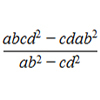
DOTS Division

Take any pair of two digit numbers x=ab and y=cd where, without loss of generality, ab > cd . Form two 4 digit numbers r=abcd and s=cdab and calculate: {r^2 - s^2} /{x^2 - y^2}.

  • Tech help
  • Accessibility Statement
  • Sign up to our newsletter
  • Twitter X logo

The NRICH Project aims to enrich the mathematical experiences of all learners. To support this aim, members of the NRICH team work in a wide range of capacities, including providing professional development for teachers wishing to embed rich mathematical tasks into everyday classroom practice.

NRICH is part of the family of activities in the Millennium Mathematics Project.

University of Cambridge logo NRICH logo