
Skip over navigation
Cambridge University Faculty of Mathematics NRich logo
menu search
  • Teachers expand_more
    • Early years
    • Primary
    • Secondary
    • Post-16
    • Events
    • Professional development
  • Students expand_more
    • Primary
    • Secondary
    • Post-16
  • Parents expand_more
    • Early Years
    • Primary
    • Secondary
    • Post-16
  • Problem-Solving Schools
  • About NRICH expand_more
    • About us
    • Impact stories
    • Support us
    • Our funders
    • Contact us
  • search

Or search by topic

Number and algebra

  • The Number System and Place Value
  • Calculations and Numerical Methods
  • Fractions, Decimals, Percentages, Ratio and Proportion
  • Properties of Numbers
  • Patterns, Sequences and Structure
  • Algebraic expressions, equations and formulae
  • Coordinates, Functions and Graphs

Geometry and measure

  • Angles, Polygons, and Geometrical Proof
  • 3D Geometry, Shape and Space
  • Measuring and calculating with units
  • Transformations and constructions
  • Pythagoras and Trigonometry
  • Vectors and Matrices

Probability and statistics

  • Handling, Processing and Representing Data
  • Probability

Working mathematically

  • Thinking mathematically
  • Developing positive attitudes
  • Cross-curricular contexts

Advanced mathematics

  • Decision Mathematics and Combinatorics
  • Advanced Probability and Statistics
  • Mechanics
  • Calculus

For younger learners

  • Early Years Foundation Stage

Temperature

Age 11 to 14
Challenge Level Yellow starYellow star
Secondary curriculum
  • Problem
  • Getting Started
  • Student Solutions
  • Teachers' Resources


Why do this problem?


This problem offers an opportunity to combine skills from mathematics and science. It can be solved numerically, algebraically or graphically, so can offer a useful opportunity for discussing the merits of different methods.
 

Possible approach

This printable worksheet may be useful: Temperature.

Introduce the boiling and freezing point of water in Celsius and Fahrenheit.

The freezing point of water is $0^\circ C$ and $32^\circ F$.
The boiling point of water is $100^\circ C$ and $212^\circ F$.
 

"What other information can you deduce from these temperature facts?"
Give the class some time to discuss in pairs, then bring the class together to collect ideas on the board. Possible responses might be:
"$50^\circ C = 122^\circ F$ because it's halfway between."
"$200^\circ C = 392^\circ F$ because it's another $180^\circ F$."
"A temperature increase of $100^\circ C$ is the same as a temperature increase of $180^\circ F$."
 
"Can you use everyone's ideas to deduce any more information about the temperature scales?"
Again, give the class some time to discuss in pairs, and then collect ideas once more.
 
"Is there a temperature where the reading in Celsius is the same as the reading in Fahrenheit?"

Give the class plenty of time to tackle this problem. As they work, circulate and look out for the different approaches they are using. Most students are likely to use a numerical approach. If some students use algebraic or graphical methods, ask them to share their approaches with the rest of the class.
 
If nobody uses algebra or graphs, ask the class to consider first how a graph might help:
"Can you represent the original information graphically in a way that could have helped you to solve the problem?"
 
The graphical method can then lead on to a discussion of the algebraic representation of the straight line graph and hence algebraic methods of solution.
 
Take time to discuss the merits of the different methods and then challenge students to show how to use each solution method to solve problems such as:
"Is there a temperature at which the Fahrenheit reading is 20 degrees higher than the Celsius reading?"
"Is there a temperature at which the Celsius reading is 20 degrees higher than the Fahrenheit reading?"
 

Key questions


Does every method give the same answer?
What are the merits of the different methods?
 

Possible support

Spend lots of time discussing how to deduce information from the initial temperature facts given. Perhaps it would help students to suggest new values if the information is presented in a table. 

Possible extension

Scientists often use the Kelvin scale of temperature, where the freezing point of water is $273.15^\circ K$ and the boiling point of water is $373.15^\circ K$. 
 
Is there a temperature at which Kelvin and Fahrenheit readings are the same?
Is there a temperature at which Kelvin and Celsius readings are the same?
 
Can you describe ways of converting Kelvin readings into Fahrenheit and Celsius readings?


You may also like

Speedy Sidney

Two trains set off at the same time from each end of a single straight railway line. A very fast bee starts off in front of the first train and flies continuously back and forth between the two trains. How far does Sidney fly before he is squashed between the two trains?

Air Nets

Can you visualise whether these nets fold up into 3D shapes? Watch the videos each time to see if you were correct.
Maths Filler

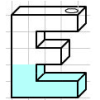
Imagine different shaped vessels being filled. Can you work out what the graphs of the water level should look like?

  • Tech help
  • Accessibility Statement
  • Sign up to our newsletter
  • Twitter X logo

The NRICH Project aims to enrich the mathematical experiences of all learners. To support this aim, members of the NRICH team work in a wide range of capacities, including providing professional development for teachers wishing to embed rich mathematical tasks into everyday classroom practice.

NRICH is part of the family of activities in the Millennium Mathematics Project.

University of Cambridge logo NRICH logo