Skip over navigation
Cambridge University Faculty of Mathematics NRich logo
menu search
  • Teachers expand_more
    • Early years
    • Primary
    • Secondary
    • Post-16
    • Events
    • Professional development
  • Students expand_more
    • Primary
    • Secondary
    • Post-16
  • Parents expand_more
    • Early Years
    • Primary
    • Secondary
    • Post-16
  • Problem-Solving Schools
  • About NRICH expand_more
    • About us
    • Impact stories
    • Support us
    • Our funders
    • Contact us
  • search

Or search by topic

Number and algebra

  • The Number System and Place Value
  • Calculations and Numerical Methods
  • Fractions, Decimals, Percentages, Ratio and Proportion
  • Properties of Numbers
  • Patterns, Sequences and Structure
  • Algebraic expressions, equations and formulae
  • Coordinates, Functions and Graphs

Geometry and measure

  • Angles, Polygons, and Geometrical Proof
  • 3D Geometry, Shape and Space
  • Measuring and calculating with units
  • Transformations and constructions
  • Pythagoras and Trigonometry
  • Vectors and Matrices

Probability and statistics

  • Handling, Processing and Representing Data
  • Probability

Working mathematically

  • Thinking mathematically
  • Developing positive attitudes
  • Cross-curricular contexts

Advanced mathematics

  • Decision Mathematics and Combinatorics
  • Advanced Probability and Statistics
  • Mechanics
  • Calculus

For younger learners

  • Early Years Foundation Stage

Bugs in the Garden

Age 5 to 7
Challenge Level Yellow starYellow star
  • Problem
  • Student Solutions
  • Teachers' Resources

Bugs in the Garden


In Sam and Jill's garden there are two sorts of ladybirds. There are red Seven-Spot ladybirds with $7$ black spots and shiny black Four-Spot ladybirds with $4$ red spots.

a red ladybird with 7 black spots and a black ladybird with 4 red spots

Sam and Jill looked at a leaf with three ladybirds on it.
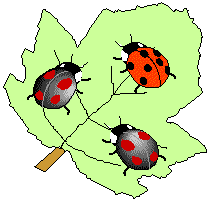
two black ladybirds, one red ladybird

"One Seven-Spot ladybird," said Sam, "and two Four-Spot ones."
"That's $15$ spots altogether!" laughed Jill.
"I wonder if we could find ladybirds whose spots add to other numbers. I know how to do $16$."
"And $14$ is easy too," added Sam.

How would you make $16$ and $14$ spots with the Seven-Spot and Four-Spot ladybirds?

What other numbers can you make with adding $4$s and $7$s?
Can you get lots of numbers from say $4$ to $35$?
Are there some numbers you can't get?


Why do this problem?

Bugs in the Garden is a good problem for children to practise addition, subtraction and possibly multiplication. It is a useful context in which to encourage learners to "have a go" and "play" with numbers, but then you can focus on having a system to find all the possible totals and giving reasons why some can't be made.

Possible approach

It would be good to have the two pictures of the bugs in the problem displayed for the children to see, either printed off or on screen. You could get them started simply by asking how many spots there are altogether on the two, then how many on the picture of the three. You might say that you're picturing some bugs on a leaf whose spots add to $16$ and ask children in pairs to think about which bugs they are.

Set the class off on the task of finding other possible totals, saying very little more. Wander round the group as they work, looking for different ways of recording and different ways of working. After 5/10 minutes, draw attention to some of these. Some might be writing number sentences, others might be drawing pictures. Some might be starting with a total, others might be starting from a combination of bugs. It is important to stress that all of these are valid and it depends what each pair finds most helpful. At this stage, remind the children that you'd like them to be sure they have found all the possible totals. How will they know? Invite them to share their ideas which could lead into a discussion of having a system, for example working in numerical order through the totals, or by using only four-spot bugs first, then only seven-spot, then both.

You could bring their ideas together by asking them to write each different total, and how they made it, on a strip of paper. Gather these strips on the board or a wall and ask the children to arrange them in numerical order. Draw out a list of numbers which haven't been made and ask all pairs to check that they're sure they are impossible. The important point here is for pupils to try to explain why these totals can't be made. Ask pairs to convince each other and then invite some explanations for all to hear.

Key questions

Which totals have you found so far? Which bugs made these totals?
What totals could we make if there are no four-spot bugs?
What totals could we make if there are no seven-spot bugs?
What totals could we made if there are both four-spot and seven-spot bugs?
How do you know you've made all the totals that are possible?
Why can't we make these totals?

Possible extension

The article, Opening Out , suggests possible routes for further investigation in general, but this problem is also mentioned specifically. Children could be asked what combination of spots would be needed to be able to generate all the numbers under $30$. Would it be possible to do this without a one-spot bug? If we couldn't use a one-spot bug, what totals would be possible?

Possible support

Some children might find it useful to have a sheet with consecutive numbers from $1$ to $29$ written on so that they can fill in ways of making each total as they go along. Calculators might be available, or other apparatus to support the arithmetic, for example a hundred square, numberline, Cuisenaire rods or counters/cubes. This document contains multiple copies of each bug which could be cut into cards. To make the task even more accessible, you could choose and create bugs with $2$ or $3$ spots instead.


You may also like

Homes

Six new homes are being built! They can be detached, semi-detached or terraced houses. How many different combinations of these can you find?

Stairs

This challenge is to design different step arrangements, which must go along a distance of 6 on the steps and must end up at 6 high.

Train Carriages

Suppose there is a train with 24 carriages which are going to be put together to make up some new trains. Can you find all the ways that this can be done?

  • Tech help
  • Accessibility Statement
  • Sign up to our newsletter
  • Twitter X logo

The NRICH Project aims to enrich the mathematical experiences of all learners. To support this aim, members of the NRICH team work in a wide range of capacities, including providing professional development for teachers wishing to embed rich mathematical tasks into everyday classroom practice.

NRICH is part of the family of activities in the Millennium Mathematics Project.

University of Cambridge logo NRICH logo