Skip over navigation


From Jacob, Luc and William at The Hall School in London we had the following, very thorough solution sent in,
We looked at the number of spots that could be produced when you have a four spotted bug or a seven spotted bug or a combination of both.
We were asked if it was possible to make $16$ and we found it is, by using four of the four spotted bugs. We discovered that the smallest number of spots we could produce was $4$.
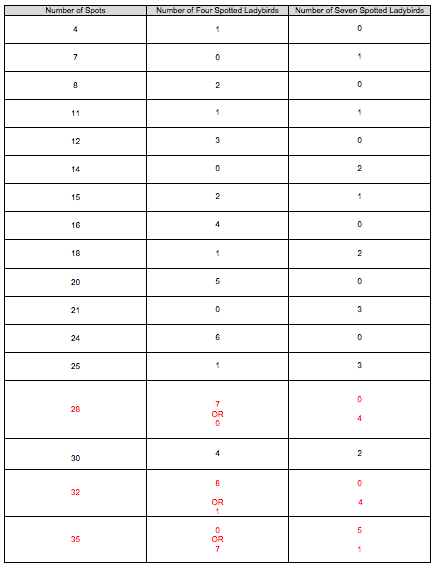
We were then asked what number of spots between $4$ and $35$ could be produced. We started off by writing a list of those numbers that did and didn't work. Then we made a table to show how we made the numbers of spots that were possible.
We found seventeen different numbers could be made and three that could be made in two different ways. These were $28, 32$ and $35$.
We have drawn a table to show the only number of spots that can be made between $4$ and $35$. For each number of spots that it is possible to make we have shown the number of four spotted and seven spotted bugs that make up the number of spots.
We also had some ideas sent in from Christian at Heronsgate School, Olivia from Risley Lower Primary School both in England. From Australia we had a solution sent in from Maths Group $2$ at Brunswick South Primary School.
Well done everyone!



Bugs in the Garden
Age 5 to 7
Challenge Level 

From Jacob, Luc and William at The Hall School in London we had the following, very thorough solution sent in,
We looked at the number of spots that could be produced when you have a four spotted bug or a seven spotted bug or a combination of both.
We were asked if it was possible to make $16$ and we found it is, by using four of the four spotted bugs. We discovered that the smallest number of spots we could produce was $4$.
We were then asked what number of spots between $4$ and $35$ could be produced. We started off by writing a list of those numbers that did and didn't work. Then we made a table to show how we made the numbers of spots that were possible.
We found seventeen different numbers could be made and three that could be made in two different ways. These were $28, 32$ and $35$.
We have drawn a table to show the only number of spots that can be made between $4$ and $35$. For each number of spots that it is possible to make we have shown the number of four spotted and seven spotted bugs that make up the number of spots.
Well done everyone!
You may also like
Homes
Six new homes are being built! They can be detached, semi-detached or terraced houses. How many different combinations of these can you find?
Stairs
This challenge is to design different step arrangements, which must go along a distance of 6 on the steps and must end up at 6 high.
Train Carriages
Suppose there is a train with 24 carriages which are going to be put together to make up some new trains. Can you find all the ways that this can be done?