Skip over navigation


This problem gives students an opportunity to do some geometrical reasoning and apply what they know about Pythagoras' theorem, area of triangles, and sequences.
Show the image:
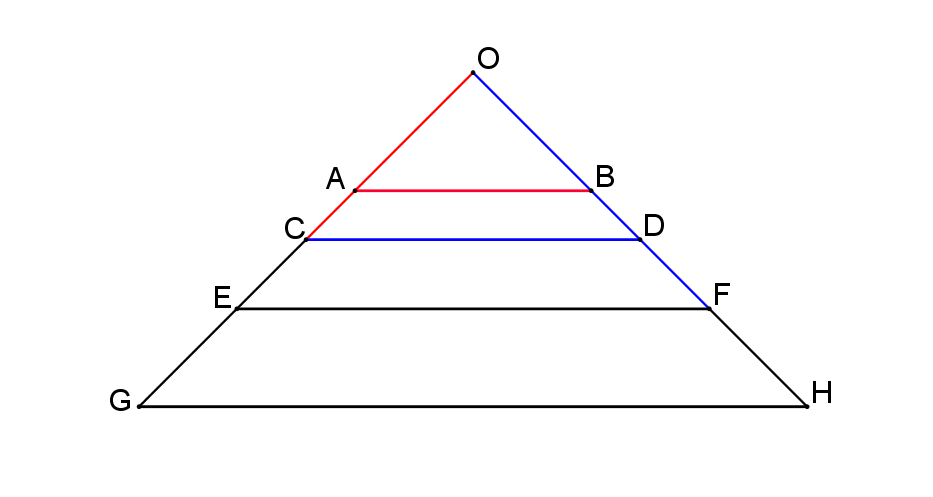
"This diagram was created by starting with a right angled isosceles triangle $OAB$ with area 1 unit."
"$AB$, $CD$, $EF$, and $GH$ are all parallel."
"$OC$ and $AB$ have the same length."
"$OE$ and $CD$ have the same length."
"$OG$ and $EF$ have the same length."
Invite students to construct the diagram for themselves, and then pose the following questions:
"Can you find the area of the trapezium $ABDC?$"
"What about trapezium $CDFE?$"
"What about trapezium $EFHG?$"
Give students some time to explore the problem, at first on their own and then with a partner. As they are working, circulate and listen out for useful strategies to discuss in a mini-plenary. If no useful strategies emerge, share with students the advice offered in Getting Started.
Any students who work out the areas quickly can consider the following: "If the pattern continued, what would be the area of the $n^{th}$ trapezium in the chain?"
Finish by discussing what students found and what strategies they used to work out the relevant areas.
Can you find an expression for the area of an isosceles right-angled triangle with two sides of length $a$?
Can you find an expression for the area of an isosceles right-angled triangle with hypotenuse $b$?
Another challenge involving areas and Pythagoras' Theorem is Compare Areas.
Some students may benefit from working on some of the Pythagoras' Theorem Short Problems before looking at this problem.

Towering Trapeziums
Age 14 to 16
Challenge Level 

Why do this problem?
This problem gives students an opportunity to do some geometrical reasoning and apply what they know about Pythagoras' theorem, area of triangles, and sequences.
Possible approach
Show the image:
"This diagram was created by starting with a right angled isosceles triangle $OAB$ with area 1 unit."
"$AB$, $CD$, $EF$, and $GH$ are all parallel."
"$OC$ and $AB$ have the same length."
"$OE$ and $CD$ have the same length."
"$OG$ and $EF$ have the same length."
Invite students to construct the diagram for themselves, and then pose the following questions:
"Can you find the area of the trapezium $ABDC?$"
"What about trapezium $CDFE?$"
"What about trapezium $EFHG?$"
Give students some time to explore the problem, at first on their own and then with a partner. As they are working, circulate and listen out for useful strategies to discuss in a mini-plenary. If no useful strategies emerge, share with students the advice offered in Getting Started.
Any students who work out the areas quickly can consider the following: "If the pattern continued, what would be the area of the $n^{th}$ trapezium in the chain?"
Finish by discussing what students found and what strategies they used to work out the relevant areas.
Key questions
Can you find an expression for the area of an isosceles right-angled triangle with two sides of length $a$?
Can you find an expression for the area of an isosceles right-angled triangle with hypotenuse $b$?
Possible extension
Another challenge involving areas and Pythagoras' Theorem is Compare Areas.
Possible support
Some students may benefit from working on some of the Pythagoras' Theorem Short Problems before looking at this problem.
You may also like
At a Glance
The area of a regular pentagon looks about twice as a big as the pentangle star drawn within it. Is it?
Six Discs
Six circular discs are packed in different-shaped boxes so that the discs touch their neighbours and the sides of the box. Can you put the boxes in order according to the areas of their bases?
Equilateral Areas
ABC and DEF are equilateral triangles of side 3 and 4 respectively. Construct an equilateral triangle whose area is the sum of the area of ABC and DEF.