Skip over navigation




Finding Circles
Age 16 to 18
Challenge Level 

Here are Jordan from St Stephen's school's answers to the warm-up:
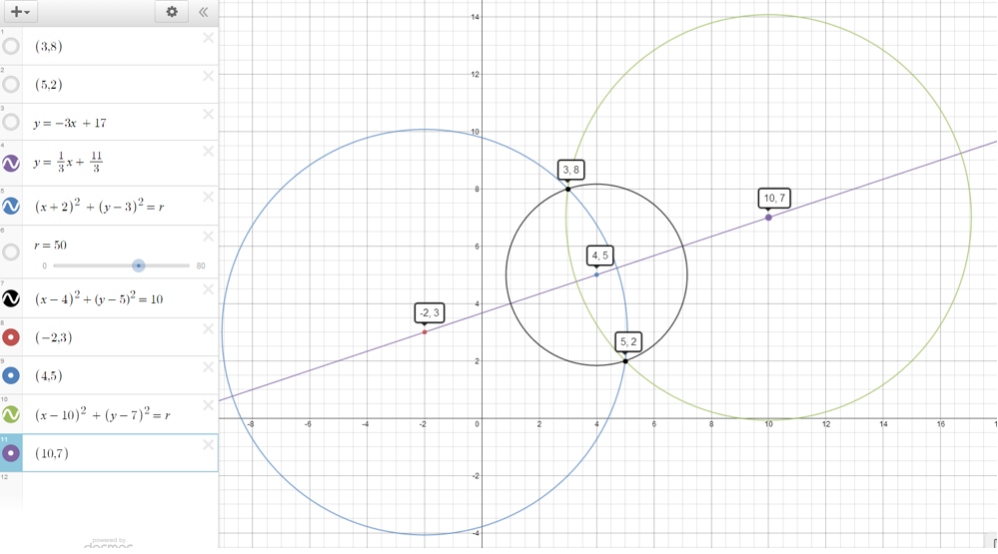
Since we are told that the points lie on the ends of a diameter of circle, the midpoint of the two points will be the centre of the circle. Therefore the x-coordinate of the centre is $\frac{3+5}{2}=4$ and the y-coordinate of the centre is $\frac{8+2}{2}=5$. Finally, we can find the radius of the circle as the distance between one of the points and the centre which we calculate by pythagoras to be $\sqrt{(5-8)^2+(4-3)^2}=\sqrt{10}$. So in summary the equation of the circle is $(x-4)^2+(y-5)^2=10$.
1. Two distinct points: There is always more than one circle that passes through them. (One thing we can observe is that the centres of such a circle lies on the line that is perpendicular to the line between the two given points, because this is the line of points that are equidistant from both given points - this turns out to be helpful for later)
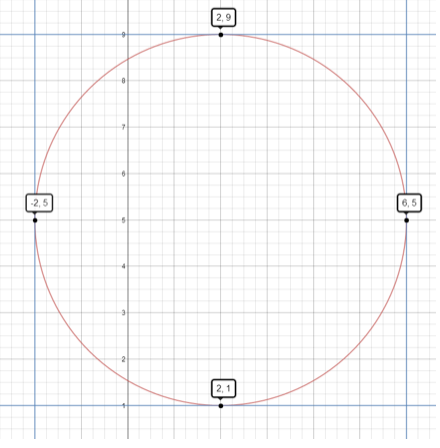
2. Three distinct points: There is a unique circle through three distinct points, unless the three points are collinear (all lie on a straight line), in which case there is no circle passing through all of them.
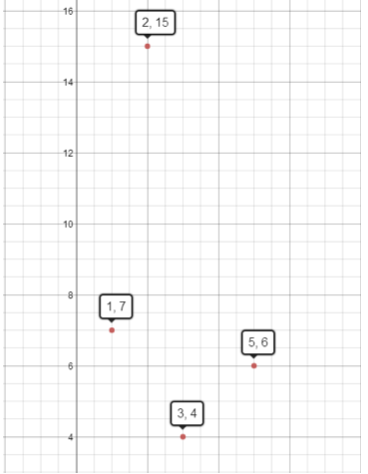
3. Four distinct points: There is not always a unique circle that passes through them. Given four random points it is likely that they don't fall on a circle.
Here is a summary of the circle equations you should have found for the main part of the problem:
1. $(x−7)^2+(y−4)^2=20$
2. $(x+1)^2+(y+1)^2=26$
3. $(x+32)^2+(y+32)^2=252$
4. $(x−76)^2+(y−56)^2=14518$
Here are two different approaches that Stephen from St Stephen's school's used to solve the main problem, showing the working for the points given in part 2.
Method 1: Using perpendicular bisectors
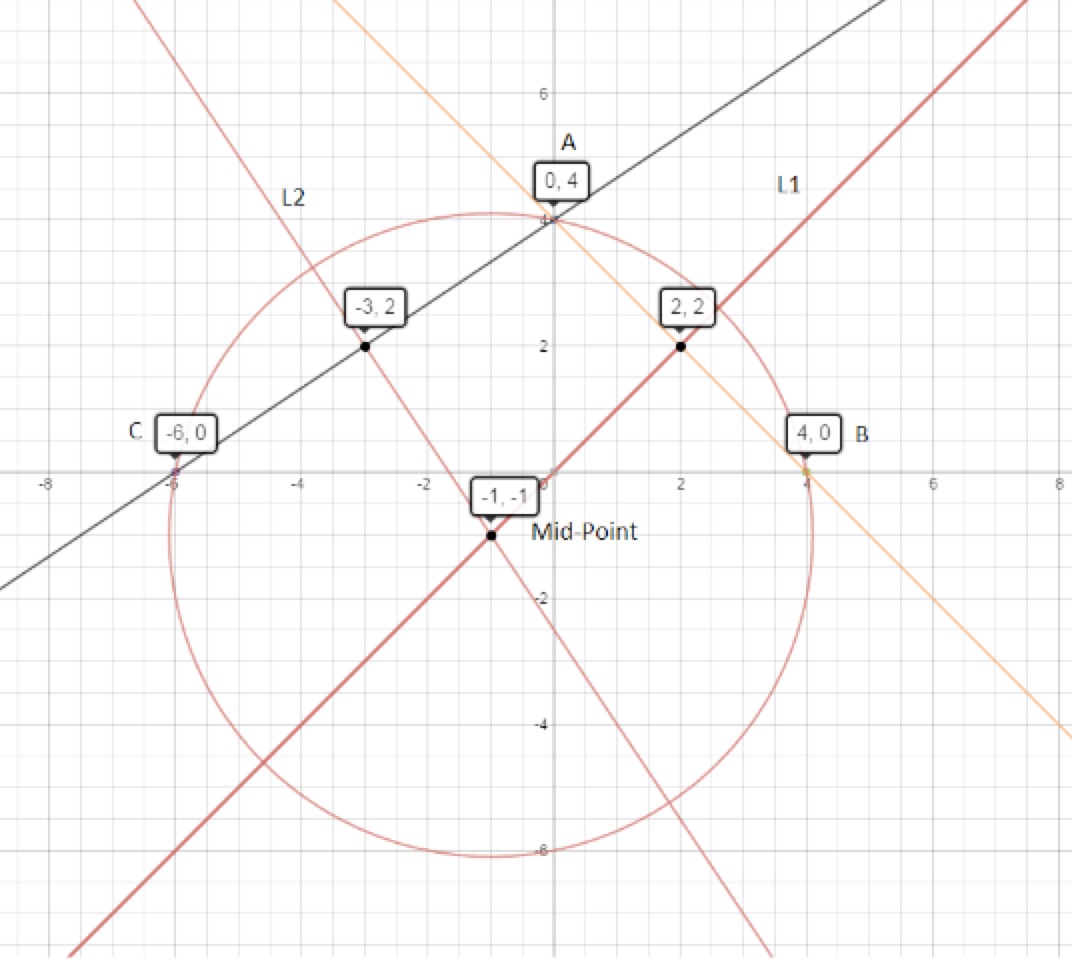
The idea behind this method starts with the observation that Jordan made in part 1 of the warm up:
Given any two points on the circle, the centre of the circle lies on the perpendicular bisector of the line between them, so this means we can find the centre of the circle as the intersection of the perpendicular bisectors of two different pairs of points.
Note that this gives a nice justification for the result in part 2 of the warm up: there is a unique circle between three points unless they are collinear, because there is a unique intersection of two lines unless they are parallel.
For example given the points in part 2: A(0,4) B(4,0) C(-6,0). We first consider the chords AB and AC and find the midpoints:
Mid point = $(\frac{x_1+x_2}{2},\frac{y_1+y_2}{2})$
Mid point of AB = $(\frac{0+4}{2},\frac{4+0}{2})=(2,2)$
Mid point of AC = $(\frac{0+-6}{2},\frac{4+0}{2})=(-3,2)$
Secondly we find the gradients of these chords:
Gradient = $(\frac{y_2-y_1}{x_2-x_1})$
Gradient of AB $= \frac{0-4}{4-0} =-1$
Gradient of AC $= \frac{0-4}{-6-0} =\frac{2}{3}$
Now we find the corresponding gradients of the perpendicular bisectors of AB and AC, call them L1 and L2 respectively.
Perpendicular gradient $= \frac{-1}{gradient}$
Gradient of L1=$\frac{-1}{-1}=1$
Gradient of L2=$\frac{-1}{\frac{2}{3}} = \frac{-3}{2}$
Now input the midpoints and gradients into the general equation of a line $y=mx+c$ to find the equations of L1 and L2:
L1: $y= mx+c$ so $2=1\times 2+c$ so $c=0$ so the equation of L1 is $y=x$
L2: $y= mx+c$ so $2=\frac{-3}{2}\times -3+c$ so $c=-2.5$ so the equation of L2 is $y=\frac{-3}{2}x-\frac{5}{2}$
So the centre of the circle is where L1 intersects L2 i.e. where:
$x=\frac{-3}{2}x-\frac{5}{2}$
$x=-1$
Substiture the x value into L1 to get that $y=-1$, so the centre of the circle is $(-1,-1)$:
Finally the radius is the distance between the centre and one of the given points:
$r=\sqrt{(0--1)^2+(4--1)^2}=\sqrt{26}$.
Hence in summary the equation of the circle through these points is:
$(x+1)^2+(y+1)^2=26$
Method 2: Simultaneous equations
The second, more algebraic approach, is to substitute the three points into the standard equation of a circle:
$$(x-a)^2+(y-b)^2=r^2$$
and solve the three simultanes equations for r, a and b:
$(0-a)^2+(4-b)^2=r^2$
$(4-a)^2+(0-b)^2=r^2$
$(-6-a)^2+(0-b)^2=r^2$
First we can eliminate r from these equations to get two simultaneous equatoins for a and b:
$(4-a)^2+(0-b)^2=(0-a)^2+(4-b)^2$
$(-6-a)^2+(0-b)^2=(0-a)^2+(4-b)^2$
We can remove all the square terms from both sides and this simplifies to:
$16-8a=16-8b$
$36+12a=16-8b$
which has solution $a=-1, b=-1$, so the centre is $(-1,-1)$
Then substitue back in to find $r=\sqrt{(0--1)^2+(4--1)^2}=\sqrt{26}$, and so the equation of the circle is $(x+1)^2+(y+1)^2=26$ as before.
Since we are told that the points lie on the ends of a diameter of circle, the midpoint of the two points will be the centre of the circle. Therefore the x-coordinate of the centre is $\frac{3+5}{2}=4$ and the y-coordinate of the centre is $\frac{8+2}{2}=5$. Finally, we can find the radius of the circle as the distance between one of the points and the centre which we calculate by pythagoras to be $\sqrt{(5-8)^2+(4-3)^2}=\sqrt{10}$. So in summary the equation of the circle is $(x-4)^2+(y-5)^2=10$.
1. Two distinct points: There is always more than one circle that passes through them. (One thing we can observe is that the centres of such a circle lies on the line that is perpendicular to the line between the two given points, because this is the line of points that are equidistant from both given points - this turns out to be helpful for later)
2. Three distinct points: There is a unique circle through three distinct points, unless the three points are collinear (all lie on a straight line), in which case there is no circle passing through all of them.
3. Four distinct points: There is not always a unique circle that passes through them. Given four random points it is likely that they don't fall on a circle.
Here is a summary of the circle equations you should have found for the main part of the problem:
1. $(x−7)^2+(y−4)^2=20$
2. $(x+1)^2+(y+1)^2=26$
3. $(x+32)^2+(y+32)^2=252$
4. $(x−76)^2+(y−56)^2=14518$
Here are two different approaches that Stephen from St Stephen's school's used to solve the main problem, showing the working for the points given in part 2.
Method 1: Using perpendicular bisectors
The idea behind this method starts with the observation that Jordan made in part 1 of the warm up:
Given any two points on the circle, the centre of the circle lies on the perpendicular bisector of the line between them, so this means we can find the centre of the circle as the intersection of the perpendicular bisectors of two different pairs of points.
Note that this gives a nice justification for the result in part 2 of the warm up: there is a unique circle between three points unless they are collinear, because there is a unique intersection of two lines unless they are parallel.
For example given the points in part 2: A(0,4) B(4,0) C(-6,0). We first consider the chords AB and AC and find the midpoints:
Mid point = $(\frac{x_1+x_2}{2},\frac{y_1+y_2}{2})$
Mid point of AB = $(\frac{0+4}{2},\frac{4+0}{2})=(2,2)$
Mid point of AC = $(\frac{0+-6}{2},\frac{4+0}{2})=(-3,2)$
Secondly we find the gradients of these chords:
Gradient = $(\frac{y_2-y_1}{x_2-x_1})$
Gradient of AB $= \frac{0-4}{4-0} =-1$
Gradient of AC $= \frac{0-4}{-6-0} =\frac{2}{3}$
Now we find the corresponding gradients of the perpendicular bisectors of AB and AC, call them L1 and L2 respectively.
Perpendicular gradient $= \frac{-1}{gradient}$
Gradient of L1=$\frac{-1}{-1}=1$
Gradient of L2=$\frac{-1}{\frac{2}{3}} = \frac{-3}{2}$
Now input the midpoints and gradients into the general equation of a line $y=mx+c$ to find the equations of L1 and L2:
L1: $y= mx+c$ so $2=1\times 2+c$ so $c=0$ so the equation of L1 is $y=x$
L2: $y= mx+c$ so $2=\frac{-3}{2}\times -3+c$ so $c=-2.5$ so the equation of L2 is $y=\frac{-3}{2}x-\frac{5}{2}$
So the centre of the circle is where L1 intersects L2 i.e. where:
$x=\frac{-3}{2}x-\frac{5}{2}$
$x=-1$
Substiture the x value into L1 to get that $y=-1$, so the centre of the circle is $(-1,-1)$:
Finally the radius is the distance between the centre and one of the given points:
$r=\sqrt{(0--1)^2+(4--1)^2}=\sqrt{26}$.
Hence in summary the equation of the circle through these points is:
$(x+1)^2+(y+1)^2=26$
Method 2: Simultaneous equations
The second, more algebraic approach, is to substitute the three points into the standard equation of a circle:
$$(x-a)^2+(y-b)^2=r^2$$
and solve the three simultanes equations for r, a and b:
$(0-a)^2+(4-b)^2=r^2$
$(4-a)^2+(0-b)^2=r^2$
$(-6-a)^2+(0-b)^2=r^2$
First we can eliminate r from these equations to get two simultaneous equatoins for a and b:
$(4-a)^2+(0-b)^2=(0-a)^2+(4-b)^2$
$(-6-a)^2+(0-b)^2=(0-a)^2+(4-b)^2$
We can remove all the square terms from both sides and this simplifies to:
$16-8a=16-8b$
$36+12a=16-8b$
which has solution $a=-1, b=-1$, so the centre is $(-1,-1)$
Then substitue back in to find $r=\sqrt{(0--1)^2+(4--1)^2}=\sqrt{26}$, and so the equation of the circle is $(x+1)^2+(y+1)^2=26$ as before.
You may also like
Powerful Quadratics
This comes in two parts, with the first being less fiendish than the second. It’s great for practising both quadratics and laws of indices, and you can get a lot from making sure that you find all the solutions. For a real challenge (requiring a bit more knowledge), you could consider finding the complex solutions.
Discriminating
You're invited to decide whether statements about the number of solutions of a quadratic equation are always, sometimes or never true.
Factorisable Quadratics
This will encourage you to think about whether all quadratics can be factorised and to develop a better understanding of the effect that changing the coefficients has on the factorised form.