Skip over navigation


Thank you to Ellen from King's College Alicante, Zach, and Pablo from King College Alicante for submitting solutions to this problem.
Ellen got us started by finding what the sequence looks like as decimals:
It's fairly simple to work out the equivalent fractions/ decimals. For
example, $1+\frac{1}{1}$ is basically $1+1$, so the first number in the sequence is $2$.
The second is basically $1+\frac{1}{2}$, using the same simplification method, which
is $1.5$. Continuing with this pattern, the sequence goes $1, 2, 1.5, 1.667, 1.6, 1.625 $etc.
The second sequence can be simplified in much the same way. The second term
is $1+\frac{1}{2}$ so the second term is equal to $1.5$. The third term can be
simplified to $1.4$. The pattern would be $1, 1.5, 1.4, 1.417, 1.413, 1.414$ etc.
In these sequences, the values get bigger and then smaller but always
between the two previous values.
Zach has made some very interesting observations about the two staircase sequences.
The first sequence:
First of all he has found the rule for how you get from one term in the sequence to the next:
The denominator in the fraction is always the preceding term.
(In mathematical notation this can be written as $T_{n+1}=1+\frac{1}{T_{n}}$ where $T_{n}$ is the $n^{th}$ term of the sequence.)
Secondly, he has written the terms of the sequence as more conventional fractions
$\frac{1}{1}, \frac{2}{1}, \frac{3}{2}, \frac{5}{3}, \frac{8}{5}, \frac{13}{8},...$
And what he noticed is that the numerators and denominators are part of the fibonacci sequence! And so he could conclude that the terms of the sequence are getting closer and closer to the golden ratio!
He has also done the same for the second sequence:
This time the denominator in the fraction is the preceding term + 1.
(In mathematical notation this can be written as $T_{n+1}=1+\frac{1}{1+T_{n}}$ where $T_{n}$ is the $n^{th}$ term of the sequence.)
The values are $\frac{1}{1},\frac{3}{2},\frac{7}{5},\frac{17}{12},\frac{41}{29},\frac{99}{70},\frac{239}{169},...$
The values of the fractions in this sequence are all getting closer to $\sqrt{2}$.
You can find his full explanations here .
Pablo has used the recurrence relations for the sequences that Zach found, to prove that the second sequence does definitely tend to $\sqrt{2}$ , and also to find an expression for the golden ratio which the first sequence tends to.
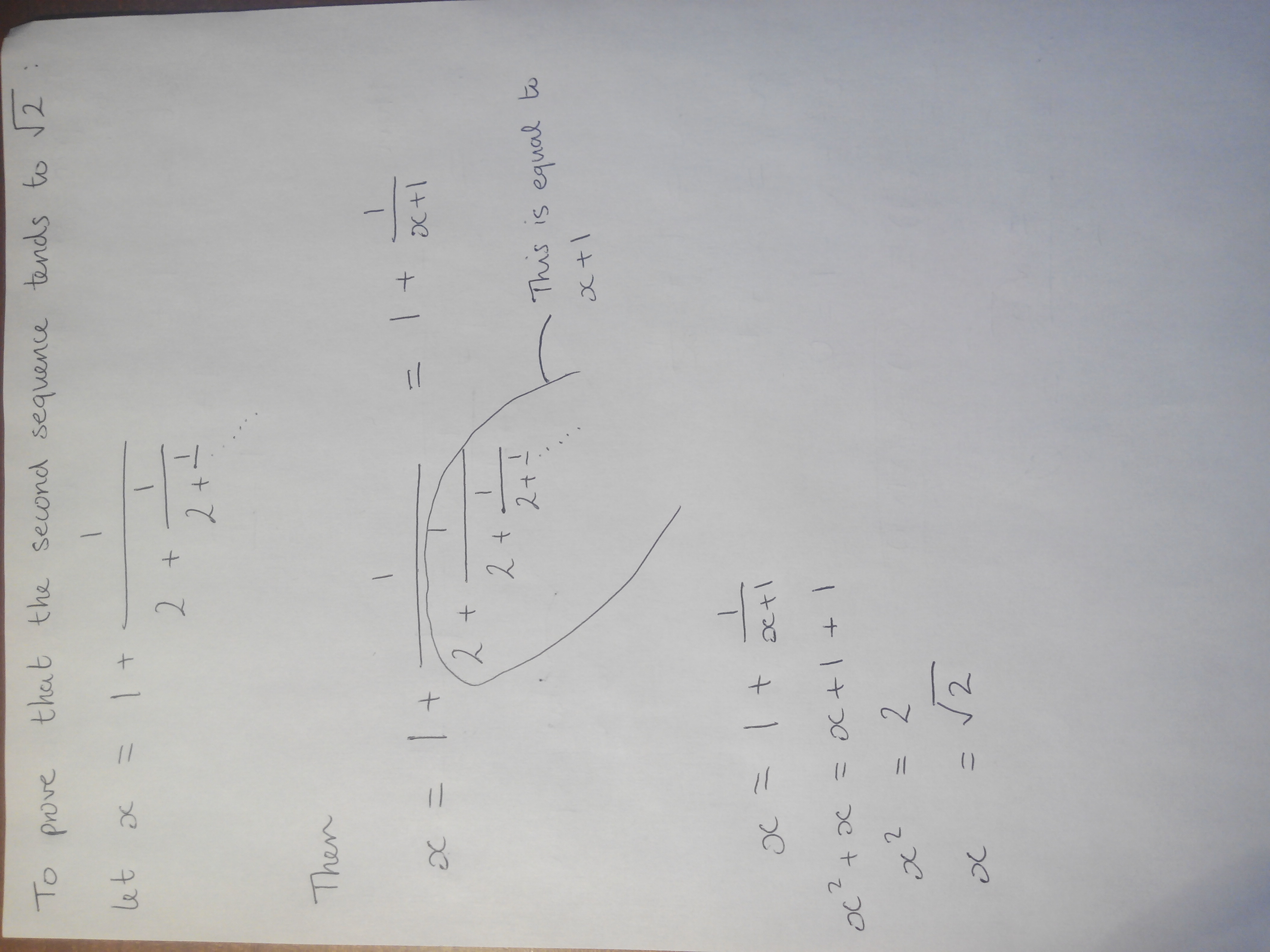
Here is his proof that the second sequence does definitely tend to $\sqrt{2}$
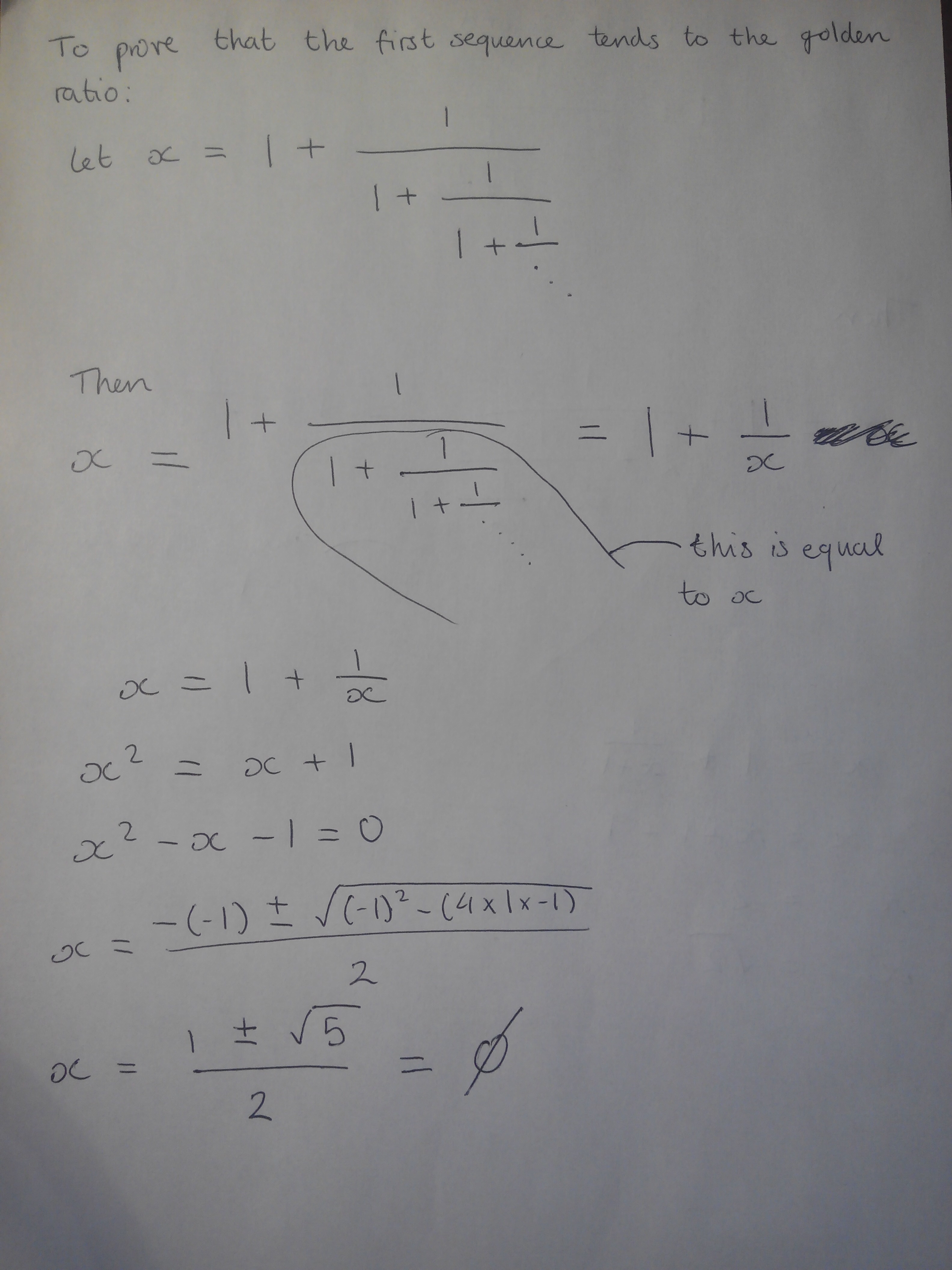
Here is how he found that the value of the golden ratio is $\frac{1+\sqrt{5}}{2}$


Staircase Sequences
Age 16 to 18
Challenge Level 

Thank you to Ellen from King's College Alicante, Zach, and Pablo from King College Alicante for submitting solutions to this problem.
Ellen got us started by finding what the sequence looks like as decimals:
It's fairly simple to work out the equivalent fractions/ decimals. For
example, $1+\frac{1}{1}$ is basically $1+1$, so the first number in the sequence is $2$.
The second is basically $1+\frac{1}{2}$, using the same simplification method, which
is $1.5$. Continuing with this pattern, the sequence goes $1, 2, 1.5, 1.667, 1.6, 1.625 $etc.
The second sequence can be simplified in much the same way. The second term
is $1+\frac{1}{2}$ so the second term is equal to $1.5$. The third term can be
simplified to $1.4$. The pattern would be $1, 1.5, 1.4, 1.417, 1.413, 1.414$ etc.
In these sequences, the values get bigger and then smaller but always
between the two previous values.
Zach has made some very interesting observations about the two staircase sequences.
The first sequence:
First of all he has found the rule for how you get from one term in the sequence to the next:
The denominator in the fraction is always the preceding term.
(In mathematical notation this can be written as $T_{n+1}=1+\frac{1}{T_{n}}$ where $T_{n}$ is the $n^{th}$ term of the sequence.)
Secondly, he has written the terms of the sequence as more conventional fractions
$\frac{1}{1}, \frac{2}{1}, \frac{3}{2}, \frac{5}{3}, \frac{8}{5}, \frac{13}{8},...$
And what he noticed is that the numerators and denominators are part of the fibonacci sequence! And so he could conclude that the terms of the sequence are getting closer and closer to the golden ratio!
He has also done the same for the second sequence:
This time the denominator in the fraction is the preceding term + 1.
(In mathematical notation this can be written as $T_{n+1}=1+\frac{1}{1+T_{n}}$ where $T_{n}$ is the $n^{th}$ term of the sequence.)
The values are $\frac{1}{1},\frac{3}{2},\frac{7}{5},\frac{17}{12},\frac{41}{29},\frac{99}{70},\frac{239}{169},...$
The values of the fractions in this sequence are all getting closer to $\sqrt{2}$.
You can find his full explanations here .
Pablo has used the recurrence relations for the sequences that Zach found, to prove that the second sequence does definitely tend to $\sqrt{2}$ , and also to find an expression for the golden ratio which the first sequence tends to.
Here is his proof that the second sequence does definitely tend to $\sqrt{2}$
Here is how he found that the value of the golden ratio is $\frac{1+\sqrt{5}}{2}$
You may also like
Powerful Quadratics
This comes in two parts, with the first being less fiendish than the second. It’s great for practising both quadratics and laws of indices, and you can get a lot from making sure that you find all the solutions. For a real challenge (requiring a bit more knowledge), you could consider finding the complex solutions.
Discriminating
You're invited to decide whether statements about the number of solutions of a quadratic equation are always, sometimes or never true.
Factorisable Quadratics
This will encourage you to think about whether all quadratics can be factorised and to develop a better understanding of the effect that changing the coefficients has on the factorised form.