Can You Make 100?


Well we had a lot of solutions sent in and here are just some that represent the kind of answers submitted.
$(1 + 2 + 3 + 4) \times 5 + 67 - ( 8 + 9 ) = 100$
$1+2+3+4+5=15$, $15\times6=90$, $90-7=83$, $83+8=91$, $91+9=100$
$1\times2+3=5$, $5\times4\times5+6= 106$, $106-7=99$, $99-8=91$, $91+9=100$
$(({8\times9}\div4)\times5) + ((7-6)+1)\times(3+2)) = 100$
$9\times8=72$, $1+2+3+4+5+6+7 = 28$, $72+28= 100$
$1+8=9$, $9\times9=81$, $81+6=87$, $87+3=90$, $90+2=92$, $92+7=99$, $99+5=104$, $104-4=100$
$5\times4=20$, $20\times3=60$, $60\times2=120$, $120-(4\times5)=100$
$(1+2+3-4)+5+6+78+9=100$
$1+2+3+4+5+6+7+(8\times9)=100$
$9\times7 = 63$, $63 + 6\times5 = 93$, $93 + 4 + 3= 100$
$(1 + (2 \times3) + (4 \times5) - 6) + 7 + (8 \times9) = 100$
$-1 \times 2 - 3 - 4 - 5 + 6\times7 + 8\times9 = 100$
$9\times6=54$, $54\times2=108$, $108-4-5=99$, $99+7=106$, $106-8=98$, $98-1=97$, $97+3=100$
$9\times8=72$, $72+7+1=80$, $80+4+6=90$, $90+5+2+3=100$
$9+1=10$, $10\times6=60$, $60+8+2=70$, $70+(7\times4)=98$, $98+5-3=100$
$1\times2+3=5$, $5\times4\times5-6=94$, $94+7+8-9=100$
$6\times4=24$, $24+1=25$, $25\times5=125$, $9+7=16$, $16+8=24$, $24-2=22$, $22+3=25$, $125-25=100$
$6+1=7$, $7\times7=49$, $9\times5=45$, $49+45=94$, $7+8=15$, $2+3+4=9$, $15-9=6$, $94+6=100$
$6+5=11$, $11\times7=77$, $4+3+9+8=24$, $24-2=22$, $22+1=23$, $77+23=100$
$6+7=13$, $13\times5=85$, $9+8=17$, $17-4=13$, $13+3=16$, $16-2=14$, $14+1=15$, $85+15=100$
$4+3=7$, $7\times9=63$, $8\times6=48$, $5\times2=10$, $48-10=38$, $38-1=37$, $63+37=100$
$4+5=9$, $9\times6=54$, $7x3=21$, $21+9=30$, $2\times8=16$, $30+16=46$, $46\times1=46$, $46+54=100$
$4+6=10$, $10\times7=70$, $7+8=15$, $15+9=24$, $24+5+2=31$, $31-1=30$, $70+30=100$
$4+7=11$, $11\times3=33$, $9\times6=54$, $8\times1=8$, $54+8=64$, $64+5=69$, $69-2=67$, $67+33=100$
$(1+9)(2+8)((7-3)\div4)(6-5) = 100$
$((1+2 + 3+4) \times (5+ 6)) + 7 - 8 - 9 = 100$
Here are some of the accounts that described the all-important processes that were used.
We started it by picking out two numbers and multiplied them together to get an answer and then we multiplied another pair of numbers to get an answer and added them together to get $87$ and added the remaining digits to get a subtotal of $100$. (Courtney and Michelle from Denfield Park Junior School)
We needed to get the biggest possible number so we multiplied the biggest numbers ($9$ and $8$). Then we added all the other numbers up in random order. We found we reached $100$ using every number.(Nadia and Millie, Greenacre School for Girls)
Our aim was to get to $50$ and double it, so we timesed $7$ by $9$ to get to $63$ and then minused it down to $60$ and then down to $50$. Then we timesed by $2$ to get $100$. (Karla and Gemma, Greenacre School for Girls)
We thought it would be good to start with number bonds to $10$. As we only had one $5$, we decided to use the other four number bonds to $10$ ($6 + 4$, $7 + 3$, $1 + 9$, $2 + 8$), and then use addition and subtraction to make $20$ and then times that by $5$ to get to $100$. (Maddie and Harriet A., Greenacre School for Girls)
Thank you to all involved - a splendid set of results!
You may also like
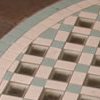
Squaring the Circle
Bluey-green, white and transparent squares with a few odd bits of shapes around the perimeter. But, how many squares are there of each type in the complete circle? Study the picture and make an estimate.