Skip over navigation


Thank you to everyone who submitted solutions to this problem.
Jessica form Tiffin Girls school has found a really nice way of organising all the given logarithms into a table.
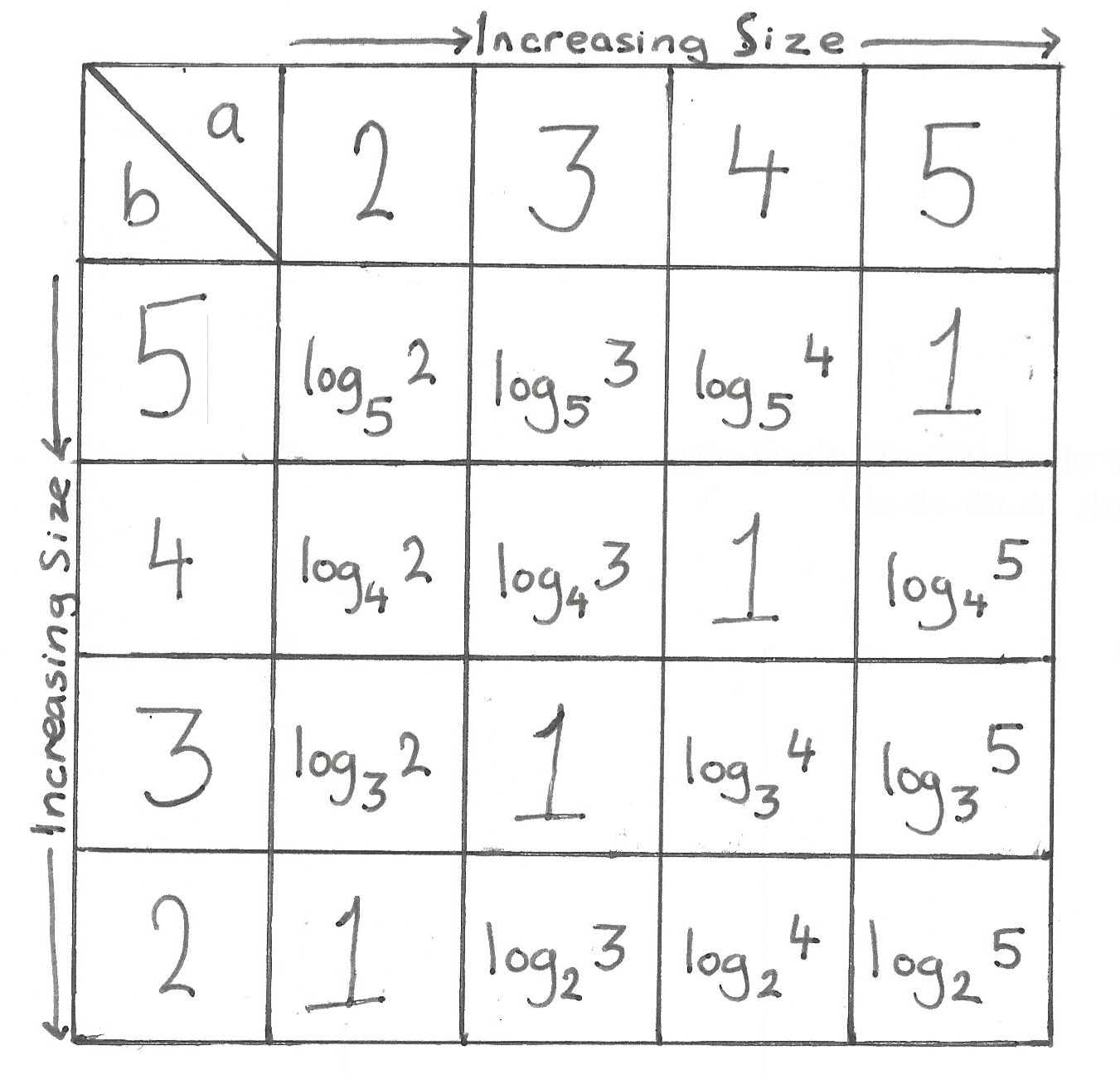
This table nicely captures all the information we can get about the relative sizes of the logarithms without calculating them, by making use of the fact that $\log_b{a}$ increases in size as you increase $a$ or decrease $b$.
It also makes it much easier to read off all the different ways you could complete the given grid, of which there are quite a few. Here is one way Jessica has given to complete the grid.
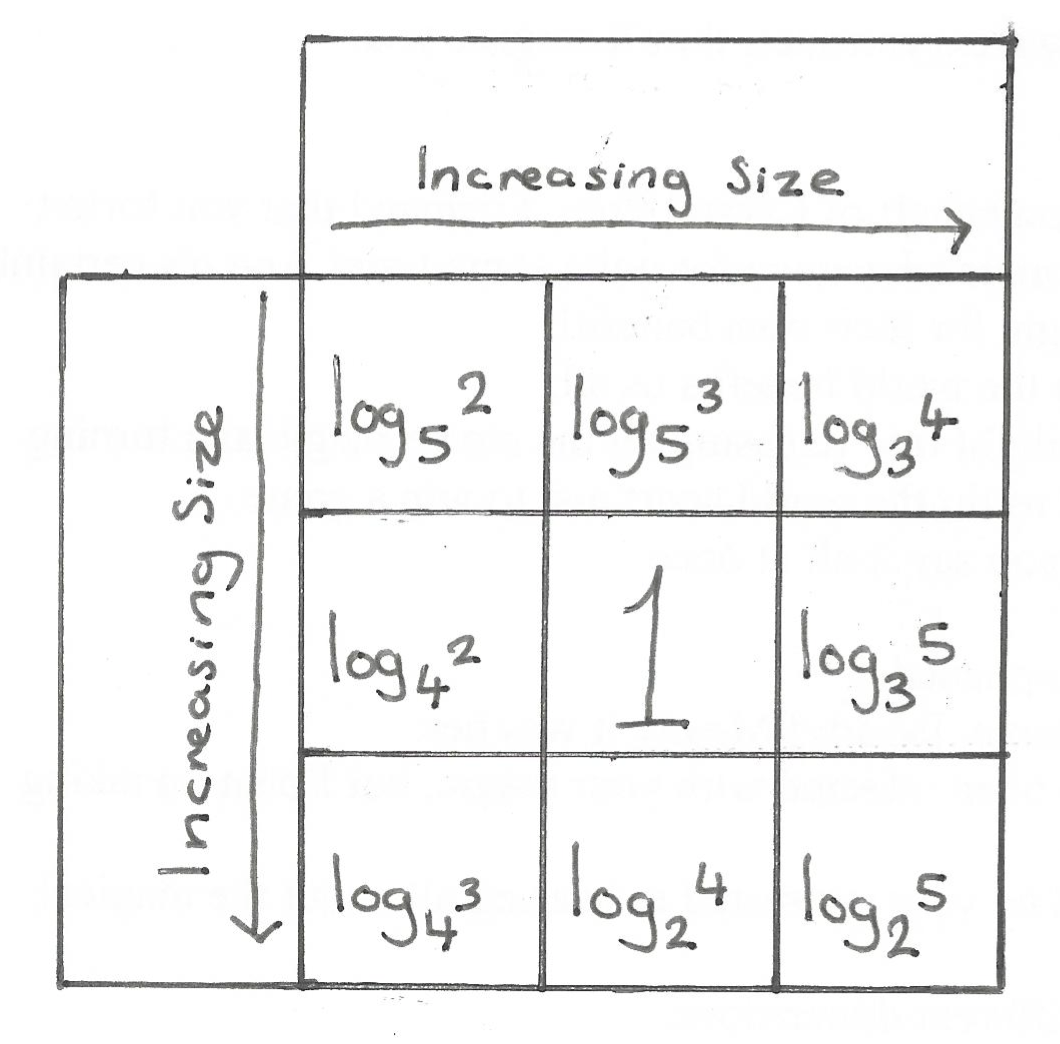
You can read Jessica's full solution here .


Log Lattice
Age 16 to 18
Challenge Level 

Thank you to everyone who submitted solutions to this problem.
Jessica form Tiffin Girls school has found a really nice way of organising all the given logarithms into a table.
This table nicely captures all the information we can get about the relative sizes of the logarithms without calculating them, by making use of the fact that $\log_b{a}$ increases in size as you increase $a$ or decrease $b$.
It also makes it much easier to read off all the different ways you could complete the given grid, of which there are quite a few. Here is one way Jessica has given to complete the grid.
You can read Jessica's full solution here .
You may also like
Powerful Quadratics
This comes in two parts, with the first being less fiendish than the second. It’s great for practising both quadratics and laws of indices, and you can get a lot from making sure that you find all the solutions. For a real challenge (requiring a bit more knowledge), you could consider finding the complex solutions.
Discriminating
You're invited to decide whether statements about the number of solutions of a quadratic equation are always, sometimes or never true.
Factorisable Quadratics
This will encourage you to think about whether all quadratics can be factorised and to develop a better understanding of the effect that changing the coefficients has on the factorised form.