Skip over navigation


In the article Vanishing Roots, we posed the question:
"What if we could have the square root of a negative number?"
and introduced $i$ as a square root of $-1$, so $i^2=-1$.

Opening the Door
Age 14 to 18
Challenge Level 

This resource is part of our Adventures with Complex Numbers collection
In the article Vanishing Roots, we posed the question:
"What if we could have the square root of a negative number?"
and introduced $i$ as a square root of $-1$, so $i^2=-1$.
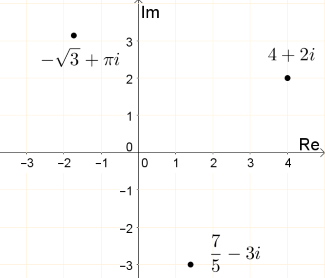
A complex number has a real part and an imaginary part, for example:
$4+ 2i$,
or $\frac{7}{5} - 3i$,
or $-\sqrt{3} + \pi i$
The complex number $a + bi$ has real part $a$ and imaginary part $b$.
In the same way that we use the number line to represent real numbers, we can use a coordinate plane to represent complex numbers. This plane is called the Argand diagram.
Adding and subtracting complex numbers is just the same as collecting like terms in algebra. For example,
$(4 + 2i) + \left(\frac{7}{5} - 3i \right) = \frac{27}{5} - i$
and
$(4 + 2i) - \left(\frac{7}{5} - 3i \right) = \frac{13}{5} + 5i$.
We have created the GeoGebra interactivity below for you to explore the questions that follow.
Use the Geogebra interactivity to find some pairs of complex numbers whose sum is a real number. What do you notice?
Can you explain it algebraically?
Use the Geogebra interactivity to find some pairs of complex numbers whose sum is an imaginary number. What do you notice?
Can you explain it algebraically?
In general, what would you need to add to $a + bi$ to get a real number? Or to get an imaginary number?
Now that you've been introduced to the world of complex numbers, you might like to start Strolling Along.
$4+ 2i$,
or $\frac{7}{5} - 3i$,
or $-\sqrt{3} + \pi i$
The complex number $a + bi$ has real part $a$ and imaginary part $b$.
In the same way that we use the number line to represent real numbers, we can use a coordinate plane to represent complex numbers. This plane is called the Argand diagram.
Adding and subtracting complex numbers is just the same as collecting like terms in algebra. For example,
$(4 + 2i) + \left(\frac{7}{5} - 3i \right) = \frac{27}{5} - i$
and
$(4 + 2i) - \left(\frac{7}{5} - 3i \right) = \frac{13}{5} + 5i$.
We have created the GeoGebra interactivity below for you to explore the questions that follow.
Use the Geogebra interactivity to find some pairs of complex numbers whose sum is a real number. What do you notice?
Can you explain it algebraically?
Use the Geogebra interactivity to find some pairs of complex numbers whose sum is an imaginary number. What do you notice?
Can you explain it algebraically?
In general, what would you need to add to $a + bi$ to get a real number? Or to get an imaginary number?
Now that you've been introduced to the world of complex numbers, you might like to start Strolling Along.
You may also like
Roots and Coefficients
If xyz = 1 and x+y+z =1/x + 1/y + 1/z show that at least one of these numbers must be 1. Now for the complexity! When are the other numbers real and when are they complex?
Target Six
Show that x = 1 is a solution of the equation x^(3/2) - 8x^(-3/2) = 7 and find all other solutions.
8 Methods for Three by One
This problem in geometry has been solved in no less than EIGHT ways by a pair of students. How would you solve it? How many of their solutions can you follow? How are they the same or different? Which do you like best?