Skip over navigation


Tilted Aquarium
Age 14 to 16
ShortChallenge Level 
The diagram on the left shows the tilted aquarium. The diagram on the right doesn't show the water, but shows the 'wet' part of the base ($80\%$) in green, and the 'dry' part of the base
($20\%$) in yellow.
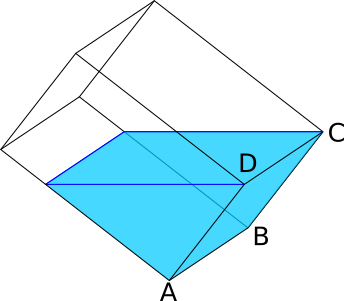
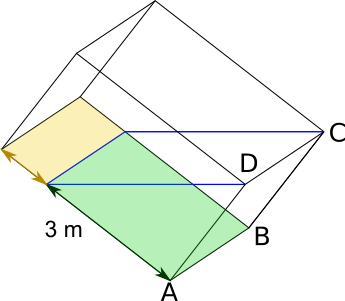
The whole length of the base is $3$ metres, as labelled above. Since the green and yellow areas are rectangles, their lengths are proportional to their areas. So the green length is $80\%$ of $3$ metres.
$80\%$ is the same as $\frac45$.
$3 \div 5 = 0.6$, and $0.6\times 4 = 2.4$. So the green length is $2.4$ m.
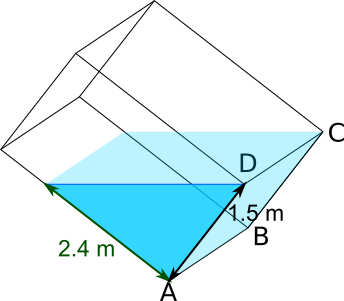 In the diagram on the left, the area that the water covers on the front face is shaded darker blue. The volume of water in the tank is equal to this area multiplied by $2$ m, the distance from the front to the back of the tank, because it is a prism.
When the tank is level, the volume of water will also be given by multiplying the area covered on the front face $2$ m. So since the volume of water is the same before and after the tank is tilted, these areas are the same.
The area that the water covers on the front face of the tilted tank is a triangle, which is right-angled at A. Its 'base' is $2.4$ m, the green length found before, and its 'height' is the original height, $1.5$ m.
So the area of the triangle is $\frac12\times1.5\times2.4 = 1.8$ m$^2$.
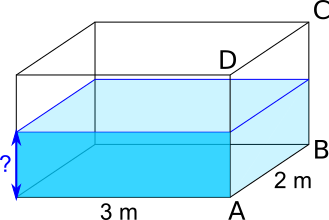 So the rectangle, showing the area that the water touhes on the front face when the aquarium is level, also has area $1.8$ m$^2$.
So $1.8 = 3\times$ the depth, which means the depth must be $0.6$ metres.
($20\%$) in yellow.
The whole length of the base is $3$ metres, as labelled above. Since the green and yellow areas are rectangles, their lengths are proportional to their areas. So the green length is $80\%$ of $3$ metres.
$80\%$ is the same as $\frac45$.
$3 \div 5 = 0.6$, and $0.6\times 4 = 2.4$. So the green length is $2.4$ m.
In the diagram on the left, the area that the water covers on the front face is shaded darker blue. The volume of water in the tank is equal to this area multiplied by $2$ m, the distance from the front to the back of the tank, because it is a prism.When the tank is level, the volume of water will also be given by multiplying the area covered on the front face $2$ m. So since the volume of water is the same before and after the tank is tilted, these areas are the same.
The area that the water covers on the front face of the tilted tank is a triangle, which is right-angled at A. Its 'base' is $2.4$ m, the green length found before, and its 'height' is the original height, $1.5$ m.
So the area of the triangle is $\frac12\times1.5\times2.4 = 1.8$ m$^2$.
So the rectangle, showing the area that the water touhes on the front face when the aquarium is level, also has area $1.8$ m$^2$.So $1.8 = 3\times$ the depth, which means the depth must be $0.6$ metres.
You can find more short problems, arranged by curriculum topic, in our short problems collection.
You may also like
Dividing the Field
A farmer has a field which is the shape of a trapezium as illustrated below. To increase his profits he wishes to grow two different crops. To do this he would like to divide the field into two trapeziums each of equal area. How could he do this?
Two Circles
Draw two circles, each of radius 1 unit, so that each circle goes through the centre of the other one. What is the area of the overlap?
Star Gazing
Find the ratio of the outer shaded area to the inner area for a six pointed star and an eight pointed star.