Skip over navigation


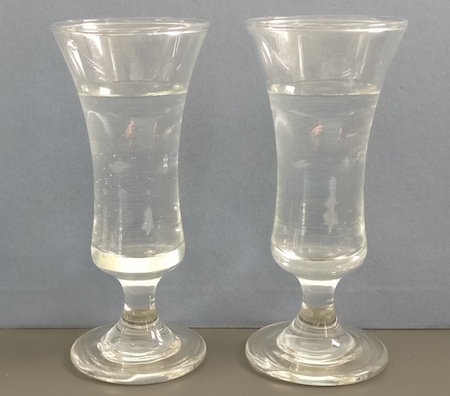
Maya has two glasses of water:
Watch this short clip to see what she starts to do:
What do you think will happen next?
Click on the 'Show' button to see the full clip and find out.
Are you surprised by the result?
Can you explain what is going on?
This task has been designed to stimulate learners' curiosity by presenting them with a surprising outcome. The intention is that the unexpected result will hook students in and encourage them to want to explain the mathematics of the situation using what they know about capacity and volume.
Whether you choose to use the image and video published here or set up a 'live' version, start by showing the class the two glasses both containing water and invite them to talk to a partner about what they see. You could share some of these observations with the whole group, then either start pouring one glass into the other or play the first clip. Give learners a few moments of individual thinking time to consider what might happen next, then encourage them to share their ideas with a partner. Take a wide variety of suggestions from the group. Learners may talk about one glass over-flowing, or there being some left in the glass that is being poured from, for example.
As they view the full video or watch you continue to pour the water, observe their reactions and challenge a few students to share how they are feeling and why. Give them plenty of time to work in pairs to unpick what is happening here. As they discuss, listen out for useful vocabulary and phrases that they are using (for example tall/taller, short/shorter, wide/wider, narrow/narrower, diameter, volume, capacity, "I think... because..." etc.) and write them up on the board for all to see.
You might ask learners to record their conclusions in some way, for example on pre-prepared card shaped like large speech bubbles, which could then be displayed. Draw attention to any pairs who make some generalisations based on the shape of the glasses.
Are you surprised by what happened? Why?
How would you explain what is going on?
Pouring Problem
Age 7 to 11
Challenge Level 

Pouring Problem
Maya has two glasses of water:
Watch this short clip to see what she starts to do:
What do you think will happen next?
Click on the 'Show' button to see the full clip and find out.
Are you surprised by the result?
Can you explain what is going on?
Why do this problem?
This task has been designed to stimulate learners' curiosity by presenting them with a surprising outcome. The intention is that the unexpected result will hook students in and encourage them to want to explain the mathematics of the situation using what they know about capacity and volume.Possible approach
You may wish to introduce this task by demonstrating the pouring yourself. (Sherry glasses are ideal!) If you do decide to set up the glasses yourself, the best way to go about it is to fill one glass completely to the brim, then decant into the second glass until the levels are the same.Whether you choose to use the image and video published here or set up a 'live' version, start by showing the class the two glasses both containing water and invite them to talk to a partner about what they see. You could share some of these observations with the whole group, then either start pouring one glass into the other or play the first clip. Give learners a few moments of individual thinking time to consider what might happen next, then encourage them to share their ideas with a partner. Take a wide variety of suggestions from the group. Learners may talk about one glass over-flowing, or there being some left in the glass that is being poured from, for example.
As they view the full video or watch you continue to pour the water, observe their reactions and challenge a few students to share how they are feeling and why. Give them plenty of time to work in pairs to unpick what is happening here. As they discuss, listen out for useful vocabulary and phrases that they are using (for example tall/taller, short/shorter, wide/wider, narrow/narrower, diameter, volume, capacity, "I think... because..." etc.) and write them up on the board for all to see.
You might ask learners to record their conclusions in some way, for example on pre-prepared card shaped like large speech bubbles, which could then be displayed. Draw attention to any pairs who make some generalisations based on the shape of the glasses.
Key questions
What do you think is going to happen next?Are you surprised by what happened? Why?
How would you explain what is going on?
Possible extension
Challenge learners to find other shapes of glasses which might create an element of surprise in the same way. Alternatively, offer them a few differently shaped glasses yourself and ask them to explain whether or not they would produce a surprising result, and why.Possible support
Writing up what you have overheard on the board, as suggested above, is a good way to help those who are struggling to get going.Related Collections
You may also like
The Big Cheese
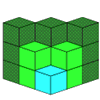
Investigate the area of 'slices' cut off this cube of cheese. What would happen if you had different-sized block of cheese to start with?
Making Boxes
Cut differently-sized square corners from a square piece of paper to make boxes without lids. Do they all have the same volume?