Skip over navigation


Bob sent us his solution:
Firstly I multiplied the matricies to find the new point. Using the trigonometric identities to simplify, I got the new point as $(r\cos(\theta+\phi),r\sin(\theta+\phi))$. This meant that we had rotated the point $\phi$ degrees anticlockwise.
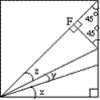
To prove that $OX = OX' = p$, I drew a line XX', which intersects and is parallel to the line $y=x\tan\theta$ (call this point of intersection D). But $DX'=DX$ and so $ODX$ and $ODX'$ are two right-angled triangles of the same size, so $OX=OX'=p$. By the same argument I drew lines $OP$ and $OP'$, and so got right-angled triangles again, so $OP=OP'=q$.
By looking at the right-angled triangle $OAX'$, with the angle at $O$ being $2\theta$, I knew that: $$\cos2\theta=\frac{OA'}{OX}=\frac{OA'}{p}$$ and so $OA'=p\cos2\theta$.
I then looked at the right-angled triangle $X'BP$, and since the angle at $X$ is $2\theta$, $BP'=q\sin2\theta$. By applying Pythagoras' Theorem to the right-angled triangle $OAX$,$AX'=p\sin2\theta$. Finally, applying Pythagoras' Thereom to the triangle $X'BP'$ I found $BX'=q\cos2\theta$.
Looking at the change in X co-ordinates, I found $P'=(p\cos2\theta+q\sin2\theta, \; p\sin2\theta-q\cos2\theta)$.
So the matrix for the reflection would be:

Rots and Refs
Age 16 to 18
Challenge Level 

Bob sent us his solution:
Firstly I multiplied the matricies to find the new point. Using the trigonometric identities to simplify, I got the new point as $(r\cos(\theta+\phi),r\sin(\theta+\phi))$. This meant that we had rotated the point $\phi$ degrees anticlockwise.
To prove that $OX = OX' = p$, I drew a line XX', which intersects and is parallel to the line $y=x\tan\theta$ (call this point of intersection D). But $DX'=DX$ and so $ODX$ and $ODX'$ are two right-angled triangles of the same size, so $OX=OX'=p$. By the same argument I drew lines $OP$ and $OP'$, and so got right-angled triangles again, so $OP=OP'=q$.
By looking at the right-angled triangle $OAX'$, with the angle at $O$ being $2\theta$, I knew that: $$\cos2\theta=\frac{OA'}{OX}=\frac{OA'}{p}$$ and so $OA'=p\cos2\theta$.
I then looked at the right-angled triangle $X'BP$, and since the angle at $X$ is $2\theta$, $BP'=q\sin2\theta$. By applying Pythagoras' Theorem to the right-angled triangle $OAX$,$AX'=p\sin2\theta$. Finally, applying Pythagoras' Thereom to the triangle $X'BP'$ I found $BX'=q\cos2\theta$.
Looking at the change in X co-ordinates, I found $P'=(p\cos2\theta+q\sin2\theta, \; p\sin2\theta-q\cos2\theta)$.
So the matrix for the reflection would be:
\mathbf{T}= \left(
\begin{array}{cc} cos 2\theta & sin2\theta\\ sin2\theta &
-\cos2\theta \end{array} \right)
You may also like to look at the
problem ' The Matrix ' from July 2003
and its solution for an explanation of how a transformation of the
plane is given by a matrix and how you can find the image of a
point by multiplying its vector by the matrix of the
transformation.
You may also like
8 Methods for Three by One
This problem in geometry has been solved in no less than EIGHT ways by a pair of students. How would you solve it? How many of their solutions can you follow? How are they the same or different? Which do you like best?
Reflect Again
Follow hints to investigate the matrix which gives a reflection of the plane in the line y=tanx. Show that the combination of two reflections in intersecting lines is a rotation.
Flipping Twisty Matrices
Investigate the transformations of the plane given by the 2 by 2 matrices with entries taking all combinations of values 0, -1 and +1.