Skip over navigation
Cambridge University Faculty of Mathematics NRich logo
menu search
  • Teachers expand_more
    • Early years
    • Primary
    • Secondary
    • Post-16
    • Events
    • Professional development
  • Students expand_more
    • Primary
    • Secondary
    • Post-16
  • Parents expand_more
    • Early Years
    • Primary
    • Secondary
    • Post-16
  • Problem-Solving Schools
  • About NRICH expand_more
    • About us
    • Impact stories
    • Support us
    • Our funders
    • Contact us
  • search

Or search by topic

Number and algebra

  • The Number System and Place Value
  • Calculations and Numerical Methods
  • Fractions, Decimals, Percentages, Ratio and Proportion
  • Properties of Numbers
  • Patterns, Sequences and Structure
  • Algebraic expressions, equations and formulae
  • Coordinates, Functions and Graphs

Geometry and measure

  • Angles, Polygons, and Geometrical Proof
  • 3D Geometry, Shape and Space
  • Measuring and calculating with units
  • Transformations and constructions
  • Pythagoras and Trigonometry
  • Vectors and Matrices

Probability and statistics

  • Handling, Processing and Representing Data
  • Probability

Working mathematically

  • Thinking mathematically
  • Developing positive attitudes
  • Cross-curricular contexts

Advanced mathematics

  • Decision Mathematics and Combinatorics
  • Advanced Probability and Statistics
  • Mechanics
  • Calculus

For younger learners

  • Early Years Foundation Stage

Fractional Triangles

Age 7 to 11
Challenge Level Yellow star
Primary curriculum
  • Problem
  • Getting Started
  • Student Solutions
  • Teachers' Resources

Fractional Triangles


Use the lines on this figure to show how the pattern of triangles can be used to divide the square into two halves, three thirds, six sixths and nine ninths.


More lines are needed to divide it into four quarters.

What is the least amount of line needed to do this if the quarters are in one piece and all the same shape?

How many ways can you divide it into halves using just the lines given?


Why do this problem?

This problem could be used as part of a lesson on finding fractions of various shapes. It should help develop an understanding of the relationship between the part and the whole. It allows children to explore fractions in a non-threatening, open-ended way and yet it does contain some real challenge.


Possible approach
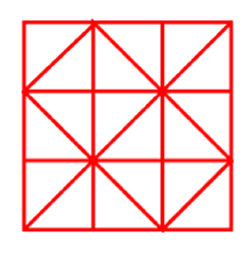
The problem could be introduced by showing the design to all the group. You could either draw it on the board or display this image on an interactive whiteboard. Alternatively, you could print out this sheet (enlarged to A3 if required). Whichever way you decide, it would be good if the image could be annotated by children during the lesson.

Ask the children what they can see and invite them to talk about it - think, pair, share. You could steer the conversation towards numbers and fractions if the children do not naturally bring it up. Asking general questions about the numbers and fractions of different shapes in the design will give children the confidence to tackle the problem.

This sheet (which contains six copies of the image) could be used both to work on and record answers to the problem. Coloured pencils would be useful to emphasise the different shapes within the design.

The final question in the problem: "How many ways can you divide it into halves using just the lines given?" could provide a useful starting point for a plenary as even those who have had difficulty with some of the questions could join in usefully.

Key questions

What fraction of the design are the small squares?
How many sixths are there in a third?

Possible extension

Children could explore the design further and find the fraction of other shapes within the design such as the diagonally placed squares formed by four small triangles.


Possible support

Those experiencing difficulty with this problem may find it easier to start by looking at a $3 \times3$ grid. Even if the rest of the class are not using it, this sheet could be useful. Some learners may find it helpful to cut out the different fractions of the square to check that they are identical. (If this is the case, several copies of the image will be needed!)

You may also like

Chocolate

There are three tables in a room with blocks of chocolate on each. Where would be the best place for each child in the class to sit if they came in one at a time?

Four Triangles Puzzle

Cut four triangles from a square as shown in the picture. How many different shapes can you make by fitting the four triangles back together?
Cut it Out

Can you dissect an equilateral triangle into 6 smaller ones? What number of smaller equilateral triangles is it NOT possible to dissect a larger equilateral triangle into?

  • Tech help
  • Accessibility Statement
  • Sign up to our newsletter
  • Twitter X logo

The NRICH Project aims to enrich the mathematical experiences of all learners. To support this aim, members of the NRICH team work in a wide range of capacities, including providing professional development for teachers wishing to embed rich mathematical tasks into everyday classroom practice.

NRICH is part of the family of activities in the Millennium Mathematics Project.

University of Cambridge logo NRICH logo