

Chocolate


This challenge is about chocolate. You have to imagine (if necessary!) that everyone involved in this challenge enjoys chocolate and wants to have as much as possible.
There's a room in your school that has three tables in it with plenty of space for chairs to go round. Table $1$ has one block of chocolate on it, table $2$ has two blocks of chocolate on it and, guess what, table $3$ has three blocks of chocolate on it.
Now ... outside the room is a class of children. Thirty of them all lined up ready to go in and eat the chocolate. These children are allowed to come in one at a time and can enter when the person in front of them has sat down. When a child enters the room they ask themself this question:
"If the chocolate on the table I sit at is to be shared out equally when I sit down, which would be the best table to sit at?"

However, the chocolate is not shared out until all the children are in the room so as each one enters they have to ask themselves the same question.
It is fairly easy for the first few children to decide where to sit, but the question gets harder to answer, e.g.
It maybe that when child $9$ comes into the room they see:
- $2$ people at table $1$
- $3$ people at table $2$
- $3$ people at table $3$
"If I go to:
- table $1$ there will be $3$ people altogether, so one block of chocolate would be shared among three and I'll get one third.
- table $2$ there will be $4$ people altogether, so two blocks of chocolate would be shared among four and I'll get one half.
- table $3$, there will be $4$ people altogether, so three blocks of chocolate would be shared among four and I'll get three quarters.
Go ahead and find out how much each child receives as they go to the "best table for them". As you write, draw and suggest ideas, try to keep a note of the different ideas, even if you get rid of some along the way.
THEN when a number of you have done this, talk to each other about what you have done, for example:
A. Compare different methods and say which you think was best.
B. Explain why it was the best.
C. If you were to do another similar challenge, how would you go about it?
You may also like
Pumpkin Pie Problem
Peter wanted to make two pies for a party. His mother had a recipe for him to use. However, she always made 80 pies at a time. Did Peter have enough ingredients to make two pumpkin pies?
Fractions in a Box
The discs for this game are kept in a flat square box with a square hole for each. Use the information to find out how many discs of each colour there are in the box.
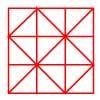
Fractional Triangles
Use the lines on this figure to show how the square can be divided into 2 halves, 3 thirds, 6 sixths and 9 ninths.