Skip over navigation


Congratulations to Angus from Bexhill College; Richard from Bournemouth School and Andrei from Tudor Vianu National College, Bucharest, Romania for their clearly explained and excellent solutions to this problem.
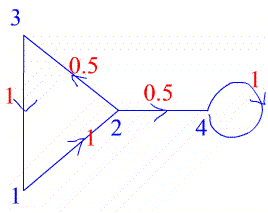
The numbers on the edges of this graph give the probabilities of a particle travelling along those edges in the direction given by the arrow. The same information is given by the entry $a_{ij}$ in the following matrix which gives the probability of travelling from vertex $i$ to vertex $j$. $$A=\left (\begin{array}{cccc} 0 &1 &0 &0\\ 0 &0 &0.5 &0.5\\ 1 &0 &0 &0\\ 0 &0 &0 &1 \end{array} \right)$$ This is Angus's solution. Firstly, we see that when we multiply matrices : $$ \left ( \begin{array}{ccc} A &B &C \\ D &E &F \\ G &H &I \end{array} \right) \left ( \begin{array}{ccc} a &b &c \\ d &e &f \\ g &h &i \end{array} \right) = \left ( \begin{array}{ccc} Aa+Bd+Cg & Ab+Be+Ch &Ac+Bf+Ci\\ Da+Ed+Fg &Db+Ee+Fh &Dc+Ef+Fi \\ Ga+Hd+Ig &Gb+He+Ih &Gc+Hf+Ii \end{array} \right) $$ and similarly for larger matrices. Hence when the matrix gives probabilities: $$A= \left( \begin{array}{cccc} P(1\to 1) &P(1\to 2) &P(1\to 3) &P(1\to 4)\\ P(2\to 1) &P(2\to 2) &P(2\to 3) &P(2\to 4)\\ P(3\to 1) &P(3\to 2) &P(3\to 3) &P(3\to 4)\\ P(4\to 1) &P(4\to 2) &P(4\to 3) &P(4\to 4) \end{array} \right)$$ where $P(1\to 2)$ is the probability of travelling to $2$ when at $1$. Then the first column of $A^2$ is: $$\left ( \begin{array}{c} P(1\to 1)P (1\to 1) + P (1\to 2) P(2\to 1) + P(1\to 3)P(3\to 1) + P(1\to 4) P(4\to 1)\\ P(2\to 1)P (1\to 1) + P (2\to 2) P(2\to 1) + P(2\to 3)P(3\to 1) + P(2\to 4) P(4\to 1)\\ P(3\to 1)P (1\to 1) + P (3\to 2) P(2\to 1) + P(3\to 3)P(3\to 1) + P(3\to 4) P(4\to 1) \\ P(4\to 1)P (1\to 1) + P(4\to 2) P(2\to 1) + P(4\to 3)P(3\to 1) + P(4\to 4) P(4\to 1) \end{array} \right ) $$ and so on for the four columns.
Now, the probability of getting from $1$ to $2$ in $x$ steps equals the sum of the probabilities of all the ways of getting from 1 to 2 in x steps : $P(1\to 2 \text{ (2 steps)}) = P(1\to 1)P(1\to 2)+ P(1\to 2)P (2\to 2)+ P(1\to 3)P(3\to 2)+\ldots$. Thus we have in $A^2$ the probability of getting from one point to another in two steps, as each entry in the matrix is the sum of probabilities of getting between the two points in two steps. Similarly, we find that if we cube the matrix, we are adding the probabilities of three-stage routes between two points, and so on for higher powers.
Now, we look at what happens for higher powers of $A$. $$A^{20}= \left( \begin{array}{cccc} 0 &0 &0.008 &0.992 \\ 0.008 &0 &0 &0.992 \\ 0 &0016 &0 &0.984 \\ 0 &0 &0 &1 \end{array} \right) $$ $$A^{21}= \left( \begin{array}{cccc} 0.008 &0 &0 &0.992 \\ 0 &0.008 &0 &0.992 \\ 0 &0 &0.008 &0.992 \\ 0 &0 &0 &1 \end{array} \right) $$ $$A^{22}= \left( \begin{array}{cccc} 0 &0.008 &0 &0.992 \\ 0 &0 &0.004 &0.996 \\ 0.008 &0 &0 &0.992 \\ 0 &0 &0 &1 \end{array} \right) $$ First (and easiest) we explain the fourth row. In the network, an object at vertex (4) has a probability of 1 of returning to (4) at the next journey. It therefore always returns to (4) and never reaches any other vertex. The fourth row will remain at $0$ $0$ $0$ $1$ as an object at (4) will remain at (4).
Next we come to the cycling of the three values in the loop at the left. At vertices (3) and (1), an object may only travel to one other vertex ((1) and (2) respectively), and at vertex (2) it travels to (3) (with a probability of $0.5$ which we ignore to explain the cycling). Therefore, an object at vertex (1) can travel to (2), then (3) then (1) again and so on. However, it moves on one vertex at a time so, if it cycles through the vertices, after n journeys the object will be at vertex $n (\text{mod } 3)$. Similarly, if it starts at (2), it will be at vertex $(n + 1)(\text{mod } 3)$ and, from (3), at $(n + 2)(\text{mod } 3)$.
Lastly, we explain the numerical values of the probabilities. Every time an object is at vertex (2), it travels to (4) with a probability p where p = 0.5 . Therefore, it will only avoid going to (4) with a probability of $(1 - p)^m$ , where $m$ is the number of times the object is at vertex (2) and $m$ is roughly $n/3$. Therefore, the probability of an object starting at vertices (1), (2) or (3) arriving at (4) is $1 - (1 - p)^m$ . As once the object is at (4) it cannot travel to any other vertex, the probability of being at (4) after n journeys can only increase.
With this information, we can predict the behaviour of $A^n$ as we let $n$ increase. All values in the fourth column will tend to one as $n$ tends to infinity, as they are given (roughly) by $1 - 0.5^{n/3}$ and $0.5^{n/3}$ tends to 0. The other nine values will cycle as shown above, in the manner : $$ \left( \begin{array}{ccc} 0 &a &0 \\ 0 &0 &b \\ c &0 &0 \end{array} \right) \to \left( \begin{array}{ccc} 0 &0 &b \\ c/2 &0 &0 \\ 0 &a &0 \end{array} \right) \to \left( \begin{array}{ccc} c/2 &0 &0 \\ 0 &a/2 &0 \\ 0 &0 &b \end{array} \right) \to \left( \begin{array}{ccc} 0 &a/2 &0 \\ 0 &0 &b/2 \\ c/2 &0 &0 \end{array} \right) $$ and so on for $n=3x+1,\ 3x+2,\ 3x+3,\ 3(x+1)+1$ respectively where $x$ is an integer.
The values of $a,\ b$ and $c$ will tend to zero as they are given by $0.5^m$ for $n$ stages where $m$ is of the order of $n/3$. Hence $$A^{100}= \left ( \begin{array}{cccc} 1 &1\times 10^{-10} &0 &0.9999999999 \\ 0 &0 &5\times 10^{-11} &0.99999999995\\ 1\times 10^{-10} &0 &0 &0.9999999999 \\ 0 &0 &0 &1 \end{array} \right)$$

Limiting Probabilities
Age 16 to 18
Challenge Level 
Congratulations to Angus from Bexhill College; Richard from Bournemouth School and Andrei from Tudor Vianu National College, Bucharest, Romania for their clearly explained and excellent solutions to this problem.
The numbers on the edges of this graph give the probabilities of a particle travelling along those edges in the direction given by the arrow. The same information is given by the entry $a_{ij}$ in the following matrix which gives the probability of travelling from vertex $i$ to vertex $j$. $$A=\left (\begin{array}{cccc} 0 &1 &0 &0\\ 0 &0 &0.5 &0.5\\ 1 &0 &0 &0\\ 0 &0 &0 &1 \end{array} \right)$$ This is Angus's solution. Firstly, we see that when we multiply matrices : $$ \left ( \begin{array}{ccc} A &B &C \\ D &E &F \\ G &H &I \end{array} \right) \left ( \begin{array}{ccc} a &b &c \\ d &e &f \\ g &h &i \end{array} \right) = \left ( \begin{array}{ccc} Aa+Bd+Cg & Ab+Be+Ch &Ac+Bf+Ci\\ Da+Ed+Fg &Db+Ee+Fh &Dc+Ef+Fi \\ Ga+Hd+Ig &Gb+He+Ih &Gc+Hf+Ii \end{array} \right) $$ and similarly for larger matrices. Hence when the matrix gives probabilities: $$A= \left( \begin{array}{cccc} P(1\to 1) &P(1\to 2) &P(1\to 3) &P(1\to 4)\\ P(2\to 1) &P(2\to 2) &P(2\to 3) &P(2\to 4)\\ P(3\to 1) &P(3\to 2) &P(3\to 3) &P(3\to 4)\\ P(4\to 1) &P(4\to 2) &P(4\to 3) &P(4\to 4) \end{array} \right)$$ where $P(1\to 2)$ is the probability of travelling to $2$ when at $1$. Then the first column of $A^2$ is: $$\left ( \begin{array}{c} P(1\to 1)P (1\to 1) + P (1\to 2) P(2\to 1) + P(1\to 3)P(3\to 1) + P(1\to 4) P(4\to 1)\\ P(2\to 1)P (1\to 1) + P (2\to 2) P(2\to 1) + P(2\to 3)P(3\to 1) + P(2\to 4) P(4\to 1)\\ P(3\to 1)P (1\to 1) + P (3\to 2) P(2\to 1) + P(3\to 3)P(3\to 1) + P(3\to 4) P(4\to 1) \\ P(4\to 1)P (1\to 1) + P(4\to 2) P(2\to 1) + P(4\to 3)P(3\to 1) + P(4\to 4) P(4\to 1) \end{array} \right ) $$ and so on for the four columns.
Now, the probability of getting from $1$ to $2$ in $x$ steps equals the sum of the probabilities of all the ways of getting from 1 to 2 in x steps : $P(1\to 2 \text{ (2 steps)}) = P(1\to 1)P(1\to 2)+ P(1\to 2)P (2\to 2)+ P(1\to 3)P(3\to 2)+\ldots$. Thus we have in $A^2$ the probability of getting from one point to another in two steps, as each entry in the matrix is the sum of probabilities of getting between the two points in two steps. Similarly, we find that if we cube the matrix, we are adding the probabilities of three-stage routes between two points, and so on for higher powers.
Now, we look at what happens for higher powers of $A$. $$A^{20}= \left( \begin{array}{cccc} 0 &0 &0.008 &0.992 \\ 0.008 &0 &0 &0.992 \\ 0 &0016 &0 &0.984 \\ 0 &0 &0 &1 \end{array} \right) $$ $$A^{21}= \left( \begin{array}{cccc} 0.008 &0 &0 &0.992 \\ 0 &0.008 &0 &0.992 \\ 0 &0 &0.008 &0.992 \\ 0 &0 &0 &1 \end{array} \right) $$ $$A^{22}= \left( \begin{array}{cccc} 0 &0.008 &0 &0.992 \\ 0 &0 &0.004 &0.996 \\ 0.008 &0 &0 &0.992 \\ 0 &0 &0 &1 \end{array} \right) $$ First (and easiest) we explain the fourth row. In the network, an object at vertex (4) has a probability of 1 of returning to (4) at the next journey. It therefore always returns to (4) and never reaches any other vertex. The fourth row will remain at $0$ $0$ $0$ $1$ as an object at (4) will remain at (4).
Next we come to the cycling of the three values in the loop at the left. At vertices (3) and (1), an object may only travel to one other vertex ((1) and (2) respectively), and at vertex (2) it travels to (3) (with a probability of $0.5$ which we ignore to explain the cycling). Therefore, an object at vertex (1) can travel to (2), then (3) then (1) again and so on. However, it moves on one vertex at a time so, if it cycles through the vertices, after n journeys the object will be at vertex $n (\text{mod } 3)$. Similarly, if it starts at (2), it will be at vertex $(n + 1)(\text{mod } 3)$ and, from (3), at $(n + 2)(\text{mod } 3)$.
Lastly, we explain the numerical values of the probabilities. Every time an object is at vertex (2), it travels to (4) with a probability p where p = 0.5 . Therefore, it will only avoid going to (4) with a probability of $(1 - p)^m$ , where $m$ is the number of times the object is at vertex (2) and $m$ is roughly $n/3$. Therefore, the probability of an object starting at vertices (1), (2) or (3) arriving at (4) is $1 - (1 - p)^m$ . As once the object is at (4) it cannot travel to any other vertex, the probability of being at (4) after n journeys can only increase.
With this information, we can predict the behaviour of $A^n$ as we let $n$ increase. All values in the fourth column will tend to one as $n$ tends to infinity, as they are given (roughly) by $1 - 0.5^{n/3}$ and $0.5^{n/3}$ tends to 0. The other nine values will cycle as shown above, in the manner : $$ \left( \begin{array}{ccc} 0 &a &0 \\ 0 &0 &b \\ c &0 &0 \end{array} \right) \to \left( \begin{array}{ccc} 0 &0 &b \\ c/2 &0 &0 \\ 0 &a &0 \end{array} \right) \to \left( \begin{array}{ccc} c/2 &0 &0 \\ 0 &a/2 &0 \\ 0 &0 &b \end{array} \right) \to \left( \begin{array}{ccc} 0 &a/2 &0 \\ 0 &0 &b/2 \\ c/2 &0 &0 \end{array} \right) $$ and so on for $n=3x+1,\ 3x+2,\ 3x+3,\ 3(x+1)+1$ respectively where $x$ is an integer.
The values of $a,\ b$ and $c$ will tend to zero as they are given by $0.5^m$ for $n$ stages where $m$ is of the order of $n/3$. Hence $$A^{100}= \left ( \begin{array}{cccc} 1 &1\times 10^{-10} &0 &0.9999999999 \\ 0 &0 &5\times 10^{-11} &0.99999999995\\ 1\times 10^{-10} &0 &0 &0.9999999999 \\ 0 &0 &0 &1 \end{array} \right)$$
You may also like
Instant Insanity
Given the nets of 4 cubes with the faces coloured in 4 colours, build a tower so that on each vertical wall no colour is repeated, that is all 4 colours appear.
Network Trees
Explore some of the different types of network, and prove a result about network trees.
Magic Caterpillars
Label the joints and legs of these graph theory caterpillars so that the vertex sums are all equal.