Skip over navigation


Why do this problem?
Scaling is a key idea in mathematics and this problem provides good practice in working with this concept and in summing geometric series. Enjoy the idea of being able to get a hold on an infinite process in a concrete way.
Possible approach
First ask the learners to work out the radius, circumference and area of the first three circles. (It is often a good strategy in problem solving to concentrate on $n=1$ first).
Then ask them to work out the radii of the next few circles; this will concentrate the thinking on scaling.
Then ask them to to work out circumferences and add them up; this will concentrate the thinking on summing series.
Key questions
Can you work out the radii of the circles?
What are the scale factors?
If you sum the circumferences what sort of series do you get?
If you sum the areas what sort of series do you get?
Can you sum these series?
Possible extension
Try the problem Von Koch Curve .
Possible support
Try the problem Smaller and Smaller.
Circles Ad Infinitum
Age 16 to 18
Challenge Level 

Why do this problem?
Scaling is a key idea in mathematics and this problem provides good practice in working with this concept and in summing geometric series. Enjoy the idea of being able to get a hold on an infinite process in a concrete way.
Possible approach
First ask the learners to work out the radius, circumference and area of the first three circles. (It is often a good strategy in problem solving to concentrate on $n=1$ first).
Then ask them to work out the radii of the next few circles; this will concentrate the thinking on scaling.
Then ask them to to work out circumferences and add them up; this will concentrate the thinking on summing series.
Key questions
Can you work out the radii of the circles?
What are the scale factors?
If you sum the circumferences what sort of series do you get?
If you sum the areas what sort of series do you get?
Can you sum these series?
Possible extension
Try the problem Von Koch Curve .
Possible support
Try the problem Smaller and Smaller.
You may also like
Generally Geometric
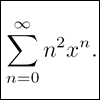
Generalise the sum of a GP by using derivatives to make the coefficients into powers of the natural numbers.
Harmonically
Is it true that a large integer m can be taken such that: 1 + 1/2 + 1/3 + ... +1/m > 100 ?