Skip over navigation


Thank you to Shaun from Nottingham High School and Andrei from Tudor Vianu National College, Bucharest, Romania for these solutions.
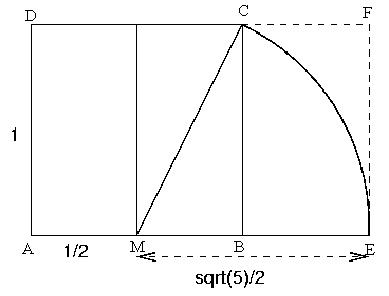
(1) Drawing the figure, I observe that ratios $AE/AD$ and $BC/BE$ are approximately equal, having a value of 1.6.
(2) From Pythagoras' Theorem I calculate $MC$ (in the right-angled triangle $MBC$): $$\eqalign{ MC^2 &= BC^2 + MB^2 = 1 + 1/4 \cr MC &= \sqrt5 /2 }.$$ So $AE=(\sqrt 5 + 1)/2$ and $BE=(\sqrt 5 - 1)/2$. The ratios are: $${AE\over AD}= {\sqrt 5 + 1\over 2}$$ and $${BC\over BE}= {1\over (\sqrt 5 - 1)/2} = {\sqrt 5 + 1\over 2}.$$ So, $AE/AD = BC/BE.$
(3) From this equality of ratios, I find out that $$BE = {AD.BC\over AE} = {1\over \phi}$$ But $AE = AB + BE$ so $$\phi = 1 + {1\over \phi}.$$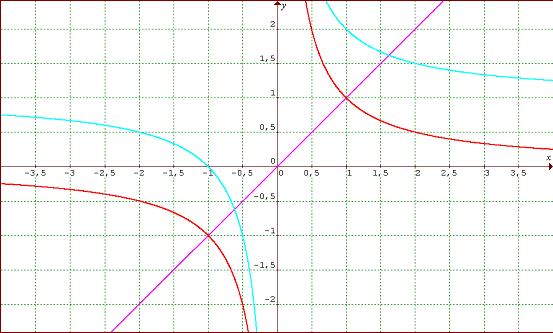
(4) Substituting $\phi = 1$ the left hand side of this expression is less than the right hand side. If we increase the value given to $\phi$ the left hand side increases and the right hand side decreases continuously. Substituting $\phi = 2$ the left hand side is greater than the right hand side so the value of $\phi$ which satisfies this equation must lie between $1$ and $2$.
The two solutions of the equation can be found at the intersection of the cyan curve ($y=1 + 1/x$) and magenta curve ($y=x)$. Only the positive value is considered and it is approximately 1.618.
(5) Now, I solve the equation. It is equivalent to $\phi^2 - \phi -1 = 0$ so the solutions are $$\phi_1 = {1-\sqrt 5\over 2}$$ and $$\phi_1 = {1+\sqrt 5 \over 2}.$$ Only the second solution is valid because $\phi > 0$ .
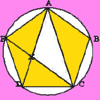
Golden Construction
Age 16 to 18
Challenge Level 

Thank you to Shaun from Nottingham High School and Andrei from Tudor Vianu National College, Bucharest, Romania for these solutions.
(1) Drawing the figure, I observe that ratios $AE/AD$ and $BC/BE$ are approximately equal, having a value of 1.6.
(2) From Pythagoras' Theorem I calculate $MC$ (in the right-angled triangle $MBC$): $$\eqalign{ MC^2 &= BC^2 + MB^2 = 1 + 1/4 \cr MC &= \sqrt5 /2 }.$$ So $AE=(\sqrt 5 + 1)/2$ and $BE=(\sqrt 5 - 1)/2$. The ratios are: $${AE\over AD}= {\sqrt 5 + 1\over 2}$$ and $${BC\over BE}= {1\over (\sqrt 5 - 1)/2} = {\sqrt 5 + 1\over 2}.$$ So, $AE/AD = BC/BE.$
(3) From this equality of ratios, I find out that $$BE = {AD.BC\over AE} = {1\over \phi}$$ But $AE = AB + BE$ so $$\phi = 1 + {1\over \phi}.$$
(4) Substituting $\phi = 1$ the left hand side of this expression is less than the right hand side. If we increase the value given to $\phi$ the left hand side increases and the right hand side decreases continuously. Substituting $\phi = 2$ the left hand side is greater than the right hand side so the value of $\phi$ which satisfies this equation must lie between $1$ and $2$.
The two solutions of the equation can be found at the intersection of the cyan curve ($y=1 + 1/x$) and magenta curve ($y=x)$. Only the positive value is considered and it is approximately 1.618.
(5) Now, I solve the equation. It is equivalent to $\phi^2 - \phi -1 = 0$ so the solutions are $$\phi_1 = {1-\sqrt 5\over 2}$$ and $$\phi_1 = {1+\sqrt 5 \over 2}.$$ Only the second solution is valid because $\phi > 0$ .
You may also like
Kissing
Two perpendicular lines are tangential to two identical circles that touch. What is the largest circle that can be placed in between the two lines and the two circles and how would you construct it?
Gold Again
Without using a calculator, computer or tables find the exact values of cos36cos72 and also cos36 - cos72.
Pentabuild
Explain how to construct a regular pentagon accurately using a straight edge and compass.