Skip over navigation


Congratulations Joseph from Colyton Grammar School, Adam from the University of Waterloo, Shaun from Nottingham High School and Andrei from Tudor Vianu National College, Bucharest, Romania for your solutions.
(1) If the area of the ellipse equals the area of the annulus then $\pi ab = \pi b^2 - \pi a^2$ and so $ab = b^2 - a^2 $. Then, dividing by $a^2$, $$ b/a = (b/a)^2 -1.$$ The ratio we want to find is $b/a$, the ratio of the longer to the shorter axis of the ellipse. So let $b/a = x$ then $$x^2 - x - 1 = 0.$$ Using quadratic formula: $$x = {1\pm \sqrt 5 \over 2}$$ We choose the positive root knowing that the ratio $b/a$ is positive so this ratio is equal to the golden ratio.
(2) Note that $R$ appears itself in the nested root. Therefore we can say $$R = \sqrt (1 + R)$$ and so $$ R^2 - R - 1 = 0.$$ We have a quadratic of the same form as above. Hence we find $R$ to be the golden ratio.


Golden Eggs
Age 16 to 18
Challenge Level 

Congratulations Joseph from Colyton Grammar School, Adam from the University of Waterloo, Shaun from Nottingham High School and Andrei from Tudor Vianu National College, Bucharest, Romania for your solutions.
(1) If the area of the ellipse equals the area of the annulus then $\pi ab = \pi b^2 - \pi a^2$ and so $ab = b^2 - a^2 $. Then, dividing by $a^2$, $$ b/a = (b/a)^2 -1.$$ The ratio we want to find is $b/a$, the ratio of the longer to the shorter axis of the ellipse. So let $b/a = x$ then $$x^2 - x - 1 = 0.$$ Using quadratic formula: $$x = {1\pm \sqrt 5 \over 2}$$ We choose the positive root knowing that the ratio $b/a$ is positive so this ratio is equal to the golden ratio.
(2) Note that $R$ appears itself in the nested root. Therefore we can say $$R = \sqrt (1 + R)$$ and so $$ R^2 - R - 1 = 0.$$ We have a quadratic of the same form as above. Hence we find $R$ to be the golden ratio.
You may also like
Converging Product
In the limit you get the sum of an infinite geometric series. What about an infinite product (1+x)(1+x^2)(1+x^4)... ?
Rain or Shine
Predict future weather using the probability that tomorrow is wet given today is wet and the probability that tomorrow is wet given that today is dry.
There's a Limit
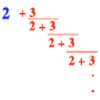
Explore the continued fraction: 2+3/(2+3/(2+3/2+...)) What do you notice when successive terms are taken? What happens to the terms if the fraction goes on indefinitely?