Skip over navigation


Chippy the Robot was sent on a journey.
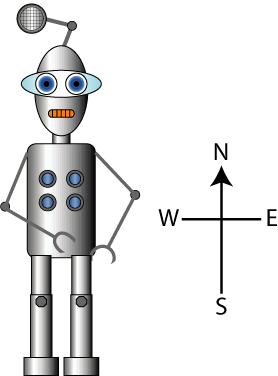
Chippy started from his base station and went $2$m (metres) N (North).
Then he turned and went $2$m E (East), $3$m N, then $3$m W (West) and $2$m S (South).
After that he went $2$m E, $3$m N and $3$m W again.
Then he went $5$m S and $4$m E.
Finally, he went $1$m S.
There he stopped.
How many metres altogether did Chippy travel on that journey?
How far and in what direction must Chippy travel to get back to his base station?
The next day Chippy went on another journey.
This time he started $3$ m (metres) West and $4$ m North of his base station. He went $6$ m E, $2$ m N, $4$ m W and $1$ m S. He then turned round and retraced his movements for $4$ m.
Where did he end up?
Can you find the shortest route to get him back to his base station?
How many metres did he have to go to get back?
Can you find him a route back which is exactly $12$ m?
How many different $12$ m routes can you find?

Chippy's Journeys
Age 7 to 11
Challenge Level 

Chippy's Journeys
Chippy the Robot was sent on a journey.
Chippy started from his base station and went $2$m (metres) N (North).
Then he turned and went $2$m E (East), $3$m N, then $3$m W (West) and $2$m S (South).
After that he went $2$m E, $3$m N and $3$m W again.
Then he went $5$m S and $4$m E.
Finally, he went $1$m S.
There he stopped.
How many metres altogether did Chippy travel on that journey?
How far and in what direction must Chippy travel to get back to his base station?
The next day Chippy went on another journey.
This time he started $3$ m (metres) West and $4$ m North of his base station. He went $6$ m E, $2$ m N, $4$ m W and $1$ m S. He then turned round and retraced his movements for $4$ m.
Where did he end up?
Can you find the shortest route to get him back to his base station?
How many metres did he have to go to get back?
Can you find him a route back which is exactly $12$ m?
How many different $12$ m routes can you find?
Why do this problem?
This problem will help to reinforce compass directions and to develop familiarity with measurement in metres.
It is an ideal opportunity for learners to use and record the vocabulary of position and direction. It could be a good time to introduce the four compass directions to describe movement about a grid.
When the problem is done on squared paper it is also an excellent opportunity to introduce the idea of scale in its most basic form.
Possible approach
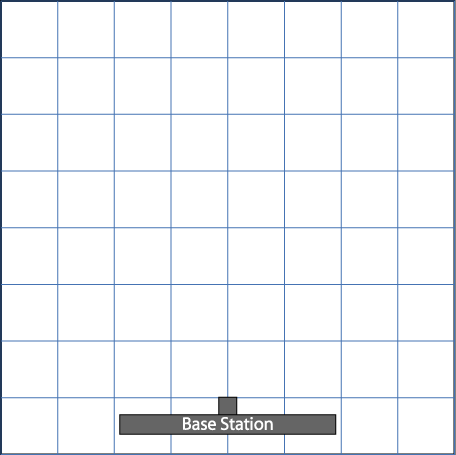
If space allows, you could start by tackling this problem practically with the class working outside or in the hall using a grid drawn on the ground. An $8$ by $8$ grid is required.
Alternatively, you could start using squared paper. This is, in any case, the next stage. You could use this image of the required grid on an interactive white board or simply draw an $8$ by $8$ grid.
After this learners could work in pairs on the actual problem from a computer or this printed sheet so that they are able to talk through their ideas with a partner. (The sheet has the whole problem, without the picture, but with a small grid which could be copied onto
squared paper.) Two larger copies of the grid can be found here.
At the end of the lesson, besides the solutions, the discussion could include reinforcement of any vocabulary used or introduced, and of how the four compass directions can describe the movement about a grid.
Key questions
How about using squared paper to draw out Chippy's route?
What will one square on the paper stand for in metres?
In which direction is North/South/East/West?
Why don't you draw the compass points on your grid?
How far does Chippy go in that direction? So where does he end up?
Possible extension
Those who found this problem easy could make their own journeys for Chippy for other learners to draw out. Alternatively, they could try The Hare and the Tortoise, a problem about speed and distance.Possible support
If at all possible suggest tackling this problem practically using a grid drawn on the ground. Otherwise use a counter on $2$ cm squared paper.You may also like
Great Squares
Investigate how this pattern of squares continues. You could measure lengths, areas and angles.
Watch the Clock
During the third hour after midnight the hands on a clock point in the same direction (so one hand is over the top of the other). At what time, to the nearest second, does this happen?
Walk and Ride
How far have these students walked by the time the teacher's car reaches them after their bus broke down?