
Skip over navigation
Cambridge University Faculty of Mathematics NRich logo
menu search
  • Teachers expand_more
    • Early years
    • Primary
    • Secondary
    • Post-16
    • Events
    • Professional development
  • Students expand_more
    • Primary
    • Secondary
    • Post-16
  • Parents expand_more
    • Early Years
    • Primary
    • Secondary
    • Post-16
  • Problem-Solving Schools
  • About NRICH expand_more
    • About us
    • Impact stories
    • Support us
    • Our funders
    • Contact us
  • search

Or search by topic

Number and algebra

  • The Number System and Place Value
  • Calculations and Numerical Methods
  • Fractions, Decimals, Percentages, Ratio and Proportion
  • Properties of Numbers
  • Patterns, Sequences and Structure
  • Algebraic expressions, equations and formulae
  • Coordinates, Functions and Graphs

Geometry and measure

  • Angles, Polygons, and Geometrical Proof
  • 3D Geometry, Shape and Space
  • Measuring and calculating with units
  • Transformations and constructions
  • Pythagoras and Trigonometry
  • Vectors and Matrices

Probability and statistics

  • Handling, Processing and Representing Data
  • Probability

Working mathematically

  • Thinking mathematically
  • Developing positive attitudes
  • Cross-curricular contexts

Advanced mathematics

  • Decision Mathematics and Combinatorics
  • Advanced Probability and Statistics
  • Mechanics
  • Calculus

For younger learners

  • Early Years Foundation Stage

Chippy's Journeys

Age 7 to 11
Challenge Level Yellow star
  • Problem
  • Getting Started
  • Student Solutions
  • Teachers' Resources

We received lots of correct answers to the first part of this problem but very few of you told us how you went about solving it. Some of you drew a diagram of Chippy's route, which was a very good way of tackling it. Rukmini from Hopscotch Nursery and Christy, sent particularly clear pictures. Here is Rukmini's:
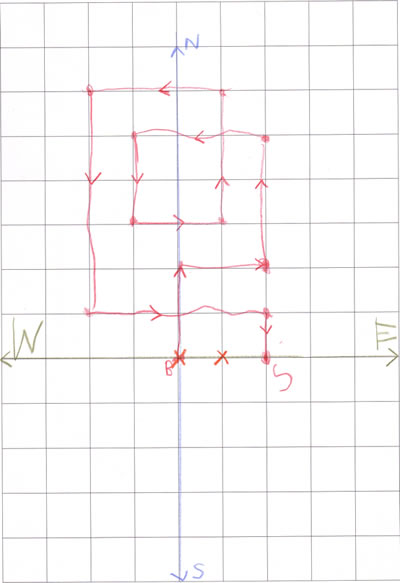

route chippy took

Rukmini says:

First I took some checked paper and drew a map showing North, East, West and South. In the centre was the Base station which I marked as B on the map. From B, I counted squares Chippy went along. He seemed to go a bit round and round till he forgot where the basic station was. I marked with a 'S' where he stopped. I drew his way back with crosses. He needed to go $2$ m West to get back to the Base station.

Tom who lives in New Zealand, solved the the first part of problem in a different, but equally as good way. Here is what Tom says:

This is a table showing how many metres Chippy went:
N S E W
2 2 2 3
3 5 2 3
3 1 4
Total 8 8 8 6
The north and the south amounts were the same so there was no change there, but the east and the west amounts were different. The east was $2$ metres more than the west. So you have to go $2$ metres in west at the end to get to Chippy's station.

Well done to you all for your well explained solutions.


You may also like

Great Squares

Investigate how this pattern of squares continues. You could measure lengths, areas and angles.

Watch the Clock

During the third hour after midnight the hands on a clock point in the same direction (so one hand is over the top of the other). At what time, to the nearest second, does this happen?
Walk and Ride

How far have these students walked by the time the teacher's car reaches them after their bus broke down?

  • Tech help
  • Accessibility Statement
  • Sign up to our newsletter
  • Twitter X logo

The NRICH Project aims to enrich the mathematical experiences of all learners. To support this aim, members of the NRICH team work in a wide range of capacities, including providing professional development for teachers wishing to embed rich mathematical tasks into everyday classroom practice.

NRICH is part of the family of activities in the Millennium Mathematics Project.

University of Cambridge logo NRICH logo