Skip over navigation



Pentabuild
Age 16 to 18
Challenge Level 

 |
Here is some information about regular pentagons.
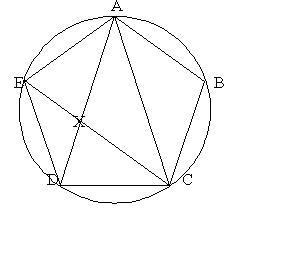
$ABCDE$ is a regular pentagon.
We first prove that triangles $AEX$ and $ADC$ are similar and
that the ratio $AD/AE$ is equal to the golden ratio ${1+\sqrt
5\over 2}$.
|
As $ABCDE$ is a regular pentagon, triangles $AEX$ and $ADC$
have angles $36^o, 72^o, 72^o$ and so they are similar isosceles
triangles. Label the side length of the pentagon $s$ so
$AE=AX=CD=CX=s$ and the chord length $c$ so $AD=EC = c$ and
$EX=c-s$. From the similar triangles $${c-s\over s}={s\over c}$$ so
writing $AD/AE=c/s = x$ gives $$x - 1 = {1\over x}$$ which is the
quadratic equation $x^2-x-1=0$ and hence, as it must be positive,
the ratio $x=AD/AE$ is the golden ratio ${1+\sqrt 5\over 2}$.
Now we can find the exact values of $\cos 72^o$ and $\cos
36^o$.
Drawing a perpendicular from $E$ to $AD$ gives a right angled
triangle from which $$\cos 36^o = {c\over 2s} ={\sqrt 5+1\over
4}.$$
Drawing a perpendicular from $A$ to $DC$ gives a right angled
triangle from which $$\cos 72^o = {s\over 2c} ={1\over2\phi}={\sqrt
5-1\over 4}.$$
In explaining the construction of a regular pentagon
coordinates are useful.
If the pentagon is inscribed in a unit circle with $A$ the
point $(0,1)$ you can find the exact coordinates of $B$ and $C$
using the exact values of $\cos 72^o$ and $\cos 36^o$ which we have
just found.
If the pentagon is inscribed in a unit circle with $A$ the
point $(0,1)$ then $B=(\sin 72^o, \cos 72^o)$ and $C=(\sin 36^o,
-\cos 36^o)$.
Hint: When you explain the construction focus on the $'y'$
coordinates of $B, C, D$ and $E$.
You may also like
Kissing
Two perpendicular lines are tangential to two identical circles that touch. What is the largest circle that can be placed in between the two lines and the two circles and how would you construct it?
Gold Again
Without using a calculator, computer or tables find the exact values of cos36cos72 and also cos36 - cos72.
Golden Construction
Draw a square and an arc of a circle and construct the Golden rectangle. Find the value of the Golden Ratio.