
Skip over navigation
Cambridge University Faculty of Mathematics NRich logo
menu search
  • Teachers expand_more
    • Early years
    • Primary
    • Secondary
    • Post-16
    • Events
    • Professional development
  • Students expand_more
    • Primary
    • Secondary
    • Post-16
  • Parents expand_more
    • Early Years
    • Primary
    • Secondary
    • Post-16
  • Problem-Solving Schools
  • About NRICH expand_more
    • About us
    • Impact stories
    • Support us
    • Our funders
    • Contact us
  • search

Or search by topic

Number and algebra

  • The Number System and Place Value
  • Calculations and Numerical Methods
  • Fractions, Decimals, Percentages, Ratio and Proportion
  • Properties of Numbers
  • Patterns, Sequences and Structure
  • Algebraic expressions, equations and formulae
  • Coordinates, Functions and Graphs

Geometry and measure

  • Angles, Polygons, and Geometrical Proof
  • 3D Geometry, Shape and Space
  • Measuring and calculating with units
  • Transformations and constructions
  • Pythagoras and Trigonometry
  • Vectors and Matrices

Probability and statistics

  • Handling, Processing and Representing Data
  • Probability

Working mathematically

  • Thinking mathematically
  • Developing positive attitudes
  • Cross-curricular contexts

Advanced mathematics

  • Decision Mathematics and Combinatorics
  • Advanced Probability and Statistics
  • Mechanics
  • Calculus

For younger learners

  • Early Years Foundation Stage

Shape and Territory

Age 16 to 18
Challenge Level Yellow starYellow star
  • Problem
  • Getting Started
  • Student Solutions
  • Teachers' Resources


Why do this problem?
It provides practice in using the tan formula and an opportunity to reflect on the bigger picture beyond school mathematics.

Possible approach
The result can be proved without using the fact that the angles add up to 180 degrees and this could be taken up as a challenge.

Then ask "What is the 'territory' this result belongs to?"

Sue's proof given here uses the fact that the angles of the triangle $ABC$ add up to 180 degrees. However it is just as easy to prove this result without using the fact about the sum of the angles of the triangle so it must be true for triangles 'living in other geometries' where the angles of triangles do not add up to 180 degrees such as Spherical Geometry.

The lines in Spherical Geometry are great circles on the surface of the sphere. By drawing lines like the lines of longitude and the equator on the earth you will soon be able to convince yourself that spherical triangles have angle sums greater than 180 degrees.

This expression gives a certain property for triangles for all 3 geometries, for Euclidean Geometry where the angles of triangles add up to 180 degrees, for Spherical (also called Elliptical) Geometry where the angles of triangles add up to more than 180 degrees and for Hyperbolic Geometry where the angles of triangles add up to less than 180 degrees.

Key question
Here we have $(A-B)$, $(B-C)$ and $(C-A)$. How can we write this using only 2 variables?

Possible extension
See the articles Strange Geometries which is accompanied by a lot of ideas for project work suitable for 12 year olds and older students on Non-Euclidean Geometries.
See also the articles How Many Geometries Are There? and
When the Angles of a Triangle don't add up to 180 degrees.


You may also like
Fixing It

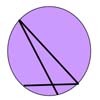
A and B are two fixed points on a circle and RS is a variable diamater. What is the locus of the intersection P of AR and BS?

Be Reasonable

Prove that sqrt2, sqrt3 and sqrt5 cannot be terms of ANY arithmetic progression.

OK! Now Prove It

Make a conjecture about the sum of the squares of the odd positive integers. Can you prove it?

  • Tech help
  • Accessibility Statement
  • Sign up to our newsletter
  • Twitter X logo

The NRICH Project aims to enrich the mathematical experiences of all learners. To support this aim, members of the NRICH team work in a wide range of capacities, including providing professional development for teachers wishing to embed rich mathematical tasks into everyday classroom practice.

NRICH is part of the family of activities in the Millennium Mathematics Project.

University of Cambridge logo NRICH logo