Skip over navigation


Take any whole number $q$. Calculate $ q^2 - 1$. Factorize $ q^2 - 1 $ to give two factors $ a$ and $ b$ (not necessarily $ q+1$ and $ q-1$). Put $ c = a + b + 2q $ . Then you will find that $ ab + 1 $ , $ bc + 1 $ and $ ca + 1 $ are all perfect squares.
Prove that this method always gives three perfect squares.

Diophantine N-tuples
Age 14 to 16
Challenge Level 
Take any whole number $q$. Calculate $ q^2 - 1$. Factorize $ q^2 - 1 $ to give two factors $ a$ and $ b$ (not necessarily $ q+1$ and $ q-1$). Put $ c = a + b + 2q $ . Then you will find that $ ab + 1 $ , $ bc + 1 $ and $ ca + 1 $ are all perfect squares.
Prove that this method always gives three perfect squares.
The numbers $ a_1, a_2, ... a_n $ are called a Diophantine n-tuple if $ a_ra_s + 1 $ is a perfect square whenever $ r \neq s $ . The whole subject started with Diophantus of Alexandria who found that the rational numbers $$ {1 \over 16},\ {33\over 16},\ {68\over 16},\ {105\over 16} $$
have this property. (You should check this for yourself). Fermat was the first person to find a Diophantine 4-tuple with whole numbers, namely $1$, $3$, $8$ and $120$. Even now no Diophantine 5-tuple with whole numbers is known.
have this property. (You should check this for yourself). Fermat was the first person to find a Diophantine 4-tuple with whole numbers, namely $1$, $3$, $8$ and $120$. Even now no Diophantine 5-tuple with whole numbers is known.
You may also like
DOTS Division
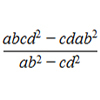
Take any pair of two digit numbers x=ab and y=cd where, without loss of generality, ab > cd . Form two 4 digit numbers r=abcd and s=cdab and calculate: {r^2 - s^2} /{x^2 - y^2}.
Sixational
The nth term of a sequence is given by the formula n^3 + 11n. Find the first four terms of the sequence given by this formula and the first term of the sequence which is bigger than one million. Prove that all terms of the sequence are divisible by 6.