Skip over navigation



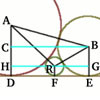
$AB=BC=CD=AD=x$, $BP=2$, $CP=3$, $AP=1$. Name the angles this way: $\angle ABP = c$, $\angle CBP = 90-c$, $\angle APB = a$, $\angle CPB = b$.
We need to find angle $a$. By the Sine Law:
$${x \over \sin b} = {3 \over \sin(90-c)} = {3\over \cos c}$$
and
$${x\over \sin a} = {1 \over \sin c}$$
Hence $\sin c = \sin a /x$, $\cos c = 3\sin b /x$ and we use the identity $\sin ^2 c + \cos ^2 c = 1$ to eliminate $c$. So
$$\eqalign { \sin ^2 (a/x^2) + 9\sin ^2 (b / x^2) &= 1 \cr \sin ^2 b &= (x^2 - \sin^2 a)/9.}$$
Using the Cosine Law we find $\cos b$ and then eliminate $b$: $$x^2 = 9 + 4 - 12 \cos b$$ so $$\cos^2 b = [(13-x^2)/12]^2.$$
Using the identity $\sin^2 b + \cos^2 b = 1$ we get $$(x^2 - \sin ^2 a)/9 + [(13 - x^2)^2]/144 = 1 \quad (1).$$
Finally we eliminate $x$. By the Cosine Law $x^2 = 4 + 1 - 4\cos a$ so
$$x^2 = 5 - 4 \cos a \quad (2).$$
Combine (1) and (2) and simplify and we get: $$2 \cos^2 a /9 + 8 /9 = 1$$ hence $\cos^2 a = 1/2.$
This yields solutions: $a=45$ or $a=135$ degrees.
Now this angle cannot be $45$ degrees because angle $c$ is smaller ($AP$ is the shortest side of triangle $APB$) and the third angle of the triangle is less than $90$ degrees. Hence angle $a$ is $135$ degrees.
Square World
Age 16 to 18
Challenge Level 

This beautifully neat solution was sent in by Johnny Chen.
If we rotate the figure by $90$ degrees about $B$ (clockwise).
This should result in a new square $A'BC'D'$ with a point $P'$
inside the new square such that, $\angle PBP'=90^{\circ}$ and
$BP=BP'=2$. By Pythagoras, $PP'= \sqrt 8$. Now consider triangle
$AP'P$. The side lengths are $3$, $\sqrt 8$, and $1$ which
satisfies Pythagoras again: $3^2 - 1^2 = (\sqrt 8)^2$.
So this triangle has $90$ degrees at $\angle P'PA$. Since we
know that $\angle BPP'=45^{\circ}$ therefore $\angle BPA$ is $135$
degrees.
This alternative method comes from Yatir from Maccabim-Reut High School, Israel.
$AB=BC=CD=AD=x$, $BP=2$, $CP=3$, $AP=1$. Name the angles this way: $\angle ABP = c$, $\angle CBP = 90-c$, $\angle APB = a$, $\angle CPB = b$.
We need to find angle $a$. By the Sine Law:
$${x \over \sin b} = {3 \over \sin(90-c)} = {3\over \cos c}$$
and
$${x\over \sin a} = {1 \over \sin c}$$
Hence $\sin c = \sin a /x$, $\cos c = 3\sin b /x$ and we use the identity $\sin ^2 c + \cos ^2 c = 1$ to eliminate $c$. So
$$\eqalign { \sin ^2 (a/x^2) + 9\sin ^2 (b / x^2) &= 1 \cr \sin ^2 b &= (x^2 - \sin^2 a)/9.}$$
Using the Cosine Law we find $\cos b$ and then eliminate $b$: $$x^2 = 9 + 4 - 12 \cos b$$ so $$\cos^2 b = [(13-x^2)/12]^2.$$
Using the identity $\sin^2 b + \cos^2 b = 1$ we get $$(x^2 - \sin ^2 a)/9 + [(13 - x^2)^2]/144 = 1 \quad (1).$$
Finally we eliminate $x$. By the Cosine Law $x^2 = 4 + 1 - 4\cos a$ so
$$x^2 = 5 - 4 \cos a \quad (2).$$
Combine (1) and (2) and simplify and we get: $$2 \cos^2 a /9 + 8 /9 = 1$$ hence $\cos^2 a = 1/2.$
This yields solutions: $a=45$ or $a=135$ degrees.
Now this angle cannot be $45$ degrees because angle $c$ is smaller ($AP$ is the shortest side of triangle $APB$) and the third angle of the triangle is less than $90$ degrees. Hence angle $a$ is $135$ degrees.
You may also like
Baby Circle
A small circle fits between two touching circles so that all three circles touch each other and have a common tangent? What is the exact radius of the smallest circle?
Logosquares
Ten squares form regular rings either with adjacent or opposite vertices touching. Calculate the inner and outer radii of the rings that surround the squares.
Two Trees
Two trees 20 metres and 30 metres long, lean across a passageway between two vertical walls. They cross at a point 8 metres above the ground. What is the distance between the foot of the trees?