Skip over navigation


This is a long and detailed hint which provides ideas, not just for this particular problem, but also for other magic graph problems where similar reasoning can be used.
Vertex Magic Investigation
There are 8 vertices and 7 edges. Let's suppose the magic constant is $h$ and this is the same at each vertex. The total of all the numbers $1 + 2 + ... + 15 = 120$ but the numbers on the edges, say $a,b,c,d,e,f,g$ are each counted twice so
$$(a+b+c+d+e+f+g)+120=8h.$$
So $a+b+c+d+e+f+g$ is a multiple of 8 and it is at least $1+2+...+7=28$ so it must be $32$ or more. Hence $8h\geq 152$ and $h\geq 19$.
It is easy to check, in a similar way, for the largest value that $h$ can take. Now it is a matter of systematically checking the possibilities for magic labellings with $h=19$ etc.
Edge Magic Investigation
How do we discover what edge magic graphs there are? Here the three order-3 vertices $a, b,c$ are counted three times and the sum of all the numbers is again $120$.
$$2(a+b+c)+120=7k.$$
Hence $k$ is even and since $a+b+c\geq 6$ we have $7k\geq 120+12=132$ and so $k\geq 20$.
If $k=20$ then $a+b+c=10$ so this triple is $1+2+7$ or $1+3+6$ or $1+4+5$ or $2+3+5$.
The possible edge sums for $k=20$ are:
$1+4+15$, $1+5+14$, $1+6+13$, $1+7+12$, $1+8+11$, $1+9+10$, $2+3+15$, $2+4+14$, $2+5+13$, $2+6+12$, $2+7+11$, $2+8+10$, $3+4+13$, $3+5+12$, $3+6+11$, $3+7+10$, $3+8+9$, $4+5+11$, $4+6+10$, $4+7+9$, $5+6+9$, $5+7+8$.
It is easy to find the edge magic labelling for $k=20$.
Moreover, substituting $16-P$ for each of the P-labels giving a magic total of $k$ will give the same numbers $1$ to $15$ and a magic total of $48-k$. So for all the magic graphs you find with a magic total of $20$ there are corresponding graphs with a magic total of $28$.
It is left for you to find the edge magic labels for $k=20$ and for $k=22$ (and correspondingly $k=26$) andfor $k=24$. Remember $k$ must be even and at least $20$ so these are the only possibilities.
Plum Tree
Age 14 to 18
Challenge Level 

This is a long and detailed hint which provides ideas, not just for this particular problem, but also for other magic graph problems where similar reasoning can be used.
Vertex Magic Investigation
There are 8 vertices and 7 edges. Let's suppose the magic constant is $h$ and this is the same at each vertex. The total of all the numbers $1 + 2 + ... + 15 = 120$ but the numbers on the edges, say $a,b,c,d,e,f,g$ are each counted twice so
$$(a+b+c+d+e+f+g)+120=8h.$$
So $a+b+c+d+e+f+g$ is a multiple of 8 and it is at least $1+2+...+7=28$ so it must be $32$ or more. Hence $8h\geq 152$ and $h\geq 19$.
It is easy to check, in a similar way, for the largest value that $h$ can take. Now it is a matter of systematically checking the possibilities for magic labellings with $h=19$ etc.
The techniques for finding the labellings are the same as used
for the
Caterpillar problem.
Edge Magic Investigation
How do we discover what edge magic graphs there are? Here the three order-3 vertices $a, b,c$ are counted three times and the sum of all the numbers is again $120$.
$$2(a+b+c)+120=7k.$$
Hence $k$ is even and since $a+b+c\geq 6$ we have $7k\geq 120+12=132$ and so $k\geq 20$.
If $k=20$ then $a+b+c=10$ so this triple is $1+2+7$ or $1+3+6$ or $1+4+5$ or $2+3+5$.
The possible edge sums for $k=20$ are:
$1+4+15$, $1+5+14$, $1+6+13$, $1+7+12$, $1+8+11$, $1+9+10$, $2+3+15$, $2+4+14$, $2+5+13$, $2+6+12$, $2+7+11$, $2+8+10$, $3+4+13$, $3+5+12$, $3+6+11$, $3+7+10$, $3+8+9$, $4+5+11$, $4+6+10$, $4+7+9$, $5+6+9$, $5+7+8$.
It is easy to find the edge magic labelling for $k=20$.
Moreover, substituting $16-P$ for each of the P-labels giving a magic total of $k$ will give the same numbers $1$ to $15$ and a magic total of $48-k$. So for all the magic graphs you find with a magic total of $20$ there are corresponding graphs with a magic total of $28$.
It is left for you to find the edge magic labels for $k=20$ and for $k=22$ (and correspondingly $k=26$) andfor $k=24$. Remember $k$ must be even and at least $20$ so these are the only possibilities.
You may also like
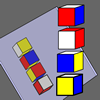
Instant Insanity
Given the nets of 4 cubes with the faces coloured in 4 colours, build a tower so that on each vertical wall no colour is repeated, that is all 4 colours appear.
Network Trees
Explore some of the different types of network, and prove a result about network trees.
Magic Caterpillars
Label the joints and legs of these graph theory caterpillars so that the vertex sums are all equal.