Skip over navigation


by Henry Kwok


Integrated Sums Sudoku
Age 11 to 16
Challenge Level 

by Henry Kwok
The Rules of "Integrated Sums Sudoku"
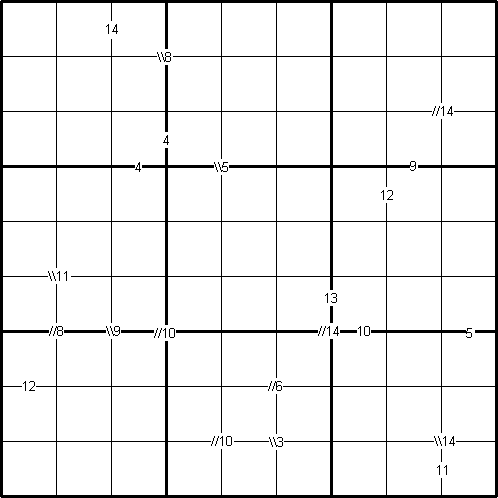
Like the standard Sudoku, this Sudoku variant consists of a grid of nine rows and nine columns subdivided into nine 3$\times$3 subgrids. Like the standard Sudoku, it has two basic rules:- Each column, each row, and each box (3$\times$3 subgrid) must have the numbers 1 to 9.
- No column, row or box can have two squares with the same number.
The puzzle can be solved with the help of small clue-numbers
which are either placed on the border lines between selected pairs
of neighbouring squares of the grid or placed after slash marks on
the intersections between two diagonally adjacent squares.
Each small clue-number is the sum of two digits in the two
squares that are horizontally or vertically or diagonally adjacent.
The position of each pair of diagonally adjacent squares is
indicated by either two forward slash marks // or two backward
slash marks \\.
For example, the //14 on the intersection between the
diagonally adjacent squares (2, 9) and (3, 8) means that possible
pairs of numbers in the squares are: 5 and 9, 9 and 5; 6 and 8, or
8 and 6 respectively.
The \\5 on intersection between the diagonally adjacent
squares (3, 4) and (4, 5) means that possible pairs of numbers in
the squares are: 1 and 4, 4 and 1; 2 and 3, or 3 and 2
respectively.
Finally, the clue-number 12 on the border line betweeen the
squares (4, 7) and (4, 8) means that possible pairs of numbers for
these squares can be from the following combinations: 3 and 9, 9
and 3; 4 and 8, 8 and 4; 5 and 7, or 7and 5.
You may also like
Days and Dates
Investigate how you can work out what day of the week your birthday will be on next year, and the year after...
Where Can We Visit?
Charlie and Abi put a counter on 42. They wondered if they could visit all the other numbers on their 1-100 board, moving the counter using just these two operations: x2 and -5. What do you think?
Prime Magic
Place the numbers 1, 2, 3,..., 9 one on each square of a 3 by 3 grid so that all the rows and columns add up to a prime number. How many different solutions can you find?