
Skip over navigation
Cambridge University Faculty of Mathematics NRich logo
menu search
  • Teachers expand_more
    • Early years
    • Primary
    • Secondary
    • Post-16
    • Events
    • Professional development
  • Students expand_more
    • Primary
    • Secondary
    • Post-16
  • Parents expand_more
    • Early Years
    • Primary
    • Secondary
    • Post-16
  • Problem-Solving Schools
  • About NRICH expand_more
    • About us
    • Impact stories
    • Support us
    • Our funders
    • Contact us
  • search

Or search by topic

Number and algebra

  • The Number System and Place Value
  • Calculations and Numerical Methods
  • Fractions, Decimals, Percentages, Ratio and Proportion
  • Properties of Numbers
  • Patterns, Sequences and Structure
  • Algebraic expressions, equations and formulae
  • Coordinates, Functions and Graphs

Geometry and measure

  • Angles, Polygons, and Geometrical Proof
  • 3D Geometry, Shape and Space
  • Measuring and calculating with units
  • Transformations and constructions
  • Pythagoras and Trigonometry
  • Vectors and Matrices

Probability and statistics

  • Handling, Processing and Representing Data
  • Probability

Working mathematically

  • Thinking mathematically
  • Developing positive attitudes
  • Cross-curricular contexts

Advanced mathematics

  • Decision Mathematics and Combinatorics
  • Advanced Probability and Statistics
  • Mechanics
  • Calculus

For younger learners

  • Early Years Foundation Stage

Three Spinners

Age 7 to 11
Challenge Level Yellow star
  • Problem
  • Getting Started
  • Student Solutions
  • Teachers' Resources

Andrew from Quarry Bay School sent us an image to show which numbers had come from each spinner:
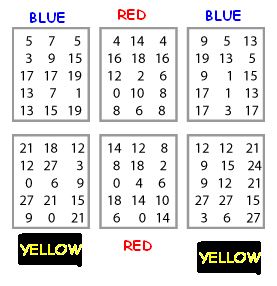

solution

Jake from Seaford Primary described how he tackled this problem:

First I wrote down all the numbers from the red list starting with the smallest. All the numbers were in the $2$ times table so I wrote the list again with the missing numbers in.
Then I did the same with the blue and yellow list.
I looked at the other six lists. Some had only $2$ times tables so I said they were from the red spinner. Some had only $3$ times tables so I said they were from the yellow spinner. Some had only odd numbers so I said they were from the blue spinner.

Ellie did a similar thing:

First of all I wrote down all the numbers you knew were on the red, yellow and blue spinners, as in the tables.
I then checked these over with the tables with no matching colours and saw which ones fitted each.
I filled in the missing numbers which were not in the first three tables and came up with $10$ numbers for each colour and titles as well.

RED - even numbers from $0$ to $18$
BLUE - odd numbers from $1$ to $19$
YELLOW - multiples of three from $0$ up to $27$

Well done also to Jonathan from New Ford Primary, children from Stourport Primary and pupils from Dr Challenor's Grammar School who all sent very clear explanations of the ways they solved this problem.


You may also like
Roll These Dice

Roll two red dice and a green dice. Add the two numbers on the red dice and take away the number on the green. What are all the different possible answers?

Bipin's Choice

Bipin is in a game show and he has picked a red ball out of 10 balls. He wins a large sum of money, but can you use the information to decided what he should do next?
Trick or Treat

Mrs. Smith had emptied packets of chocolate-covered mice, plastic frogs and gummi-worms into a cauldron for treats. What treat is Trixie most likely to pick out?

  • Tech help
  • Accessibility Statement
  • Sign up to our newsletter
  • Twitter X logo

The NRICH Project aims to enrich the mathematical experiences of all learners. To support this aim, members of the NRICH team work in a wide range of capacities, including providing professional development for teachers wishing to embed rich mathematical tasks into everyday classroom practice.

NRICH is part of the family of activities in the Millennium Mathematics Project.

University of Cambridge logo NRICH logo