Skip over navigation
Cambridge University Faculty of Mathematics NRich logo
menu search
  • Teachers expand_more
    • Early years
    • Primary
    • Secondary
    • Post-16
    • Events
    • Professional development
  • Students expand_more
    • Primary
    • Secondary
    • Post-16
  • Parents expand_more
    • Early Years
    • Primary
    • Secondary
    • Post-16
  • Problem-Solving Schools
  • About NRICH expand_more
    • About us
    • Impact stories
    • Support us
    • Our funders
    • Contact us
  • search

Or search by topic

Number and algebra

  • The Number System and Place Value
  • Calculations and Numerical Methods
  • Fractions, Decimals, Percentages, Ratio and Proportion
  • Properties of Numbers
  • Patterns, Sequences and Structure
  • Algebraic expressions, equations and formulae
  • Coordinates, Functions and Graphs

Geometry and measure

  • Angles, Polygons, and Geometrical Proof
  • 3D Geometry, Shape and Space
  • Measuring and calculating with units
  • Transformations and constructions
  • Pythagoras and Trigonometry
  • Vectors and Matrices

Probability and statistics

  • Handling, Processing and Representing Data
  • Probability

Working mathematically

  • Thinking mathematically
  • Developing positive attitudes
  • Cross-curricular contexts

Advanced mathematics

  • Decision Mathematics and Combinatorics
  • Advanced Probability and Statistics
  • Mechanics
  • Calculus

For younger learners

  • Early Years Foundation Stage

Two-digit Targets

Age 5 to 7
Challenge Level Yellow star
Primary curriculum
  • Problem
  • Getting Started
  • Student Solutions
  • Teachers' Resources

Two-digit Targets

Two-digit Targets printable sheet


You have a set of the digits from $0$ - $9$.

0 - 9


Can you arrange these digits in the five boxes below to make two-digit numbers as close to the targets as possible? You may use each digit once only.
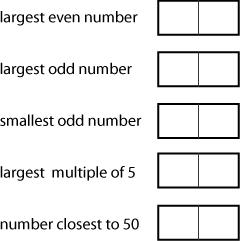


How will you know that your solution is as close to the targets as possible?

You could use this interactivity to try out your ideas.


This activity has been adapted from one of BEAM's free Maths of the Month resources, which unfortunately are no longer available.


Printable NRICH Roadshow resource. 


Why do this problem?

This problem is a fantastic opportunity for learners to apply knowledge of place value and offers a context for learning and practising the relevant vocabulary (odd, even, multiple).  The interactivity will help learners satisfy their curiosity in the sense of finding a 'better' solution, as it enables them to play around with the digits without having to commit anything to paper.  This act of deciding whether one solution is better than another also provides a meaningful context in which to compare and order numbers.


Possible approach

 
You could start by having two different digits and asking how the digits could be arranged to make the number that is the larger/smaller. Try this several times with different combinations of two digits. Could the digits be arranged to make a multiple of $5$? If not, why not?
 
Next you could introduce one of the criteria in the problem, such as making the largest possible even two-digit number. Alternatively, you could make up your own examples such as the largest even number or the nearest to $70$. You will need to establish whether $0$ can be used at the beginning of a number. This, in itself, can form an interesting discussion point. (The final decision itself does not matter - it is the reasons that are important, and the fact that the children feel as if it is their decision!)


Give pairs time to continue working on this problem, using the interactivity and/or a set of digit cards.  Pairs may find this sheet useful for recording their thinking.


In the plenary, facilitate a general discussion on the strategies learners used to tackle the task and how they determined how 'good' a solution was.  


Key questions


What have you tried so far?
What do you know about odd numbers/even numbers/multiples of 5? How does this help you place the digits?
Can you create a 'better' solution?  How will you know it is better?


Possible extension

Some children might like the challenge of this four-digit version of the task.


Possible support

Making the numbers one at a time with set of $0$ - $9$ digit cards, or using the interactivity, should help all children access this problem.

You may also like

I'm Eight

Find a great variety of ways of asking questions which make 8.

Let's Investigate Triangles

Vincent and Tara are making triangles with the class construction set. They have a pile of strips of different lengths. How many different triangles can they make?

Noah

Noah saw 12 legs walk by into the Ark. How many creatures did he see?

  • Tech help
  • Accessibility Statement
  • Sign up to our newsletter
  • Twitter X logo

The NRICH Project aims to enrich the mathematical experiences of all learners. To support this aim, members of the NRICH team work in a wide range of capacities, including providing professional development for teachers wishing to embed rich mathematical tasks into everyday classroom practice.

NRICH is part of the family of activities in the Millennium Mathematics Project.

University of Cambridge logo NRICH logo