Skip over navigation


Richard of Mearns Castle High School sent us in this solution:
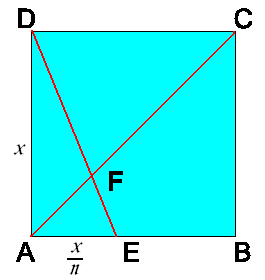
Notice that $AE = \frac{1}{n} AB = \frac{1}{n}x$
We can say that $\triangle AEF$ and $\triangle DCF$ are similar. This is because $\angle AFE$ is equal to $\angle DFC$ (vertically opposite). Also $\angle FAE = \angle FCD$ and $\angle AEF = \angle CDF$ (alternate angles).
Since the triangles are similar we can say that the ratios of corresponding sides are the same. Therefore:
$$\eqalign{
\frac {DC}{AE} &= \frac{FC}{AF}\cr
\frac{x}{\frac{x}{n}}&= \frac{FC}{AF}\cr
n &= \frac{FC}{AF}
}$$
Hence$$FC = AF \times n $$
So $DE$ cuts $AC$ at the ratio $1:n$.
Folding Fractions
Age 14 to 16
Challenge Level 

Richard of Mearns Castle High School sent us in this solution:
Notice that $AE = \frac{1}{n} AB = \frac{1}{n}x$
We can say that $\triangle AEF$ and $\triangle DCF$ are similar. This is because $\angle AFE$ is equal to $\angle DFC$ (vertically opposite). Also $\angle FAE = \angle FCD$ and $\angle AEF = \angle CDF$ (alternate angles).
Since the triangles are similar we can say that the ratios of corresponding sides are the same. Therefore:
$$\eqalign{
\frac {DC}{AE} &= \frac{FC}{AF}\cr
\frac{x}{\frac{x}{n}}&= \frac{FC}{AF}\cr
n &= \frac{FC}{AF}
}$$
Hence$$FC = AF \times n $$
So $DE$ cuts $AC$ at the ratio $1:n$.
You may also like
Triangle Midpoints
You are only given the three midpoints of the sides of a triangle. How can you construct the original triangle?
Pareq Exists
Prove that, given any three parallel lines, an equilateral triangle always exists with one vertex on each of the three lines.
The Medieval Octagon
Medieval stonemasons used a method to construct octagons using ruler and compasses... Is the octagon regular? Proof please.