
Skip over navigation
Cambridge University Faculty of Mathematics NRich logo
menu search
  • Teachers expand_more
    • Early years
    • Primary
    • Secondary
    • Post-16
    • Events
    • Professional development
  • Students expand_more
    • Primary
    • Secondary
    • Post-16
  • Parents expand_more
    • Early Years
    • Primary
    • Secondary
    • Post-16
  • Problem-Solving Schools
  • About NRICH expand_more
    • About us
    • Impact stories
    • Support us
    • Our funders
    • Contact us
  • search

Or search by topic

Number and algebra

  • The Number System and Place Value
  • Calculations and Numerical Methods
  • Fractions, Decimals, Percentages, Ratio and Proportion
  • Properties of Numbers
  • Patterns, Sequences and Structure
  • Algebraic expressions, equations and formulae
  • Coordinates, Functions and Graphs

Geometry and measure

  • Angles, Polygons, and Geometrical Proof
  • 3D Geometry, Shape and Space
  • Measuring and calculating with units
  • Transformations and constructions
  • Pythagoras and Trigonometry
  • Vectors and Matrices

Probability and statistics

  • Handling, Processing and Representing Data
  • Probability

Working mathematically

  • Thinking mathematically
  • Developing positive attitudes
  • Cross-curricular contexts

Advanced mathematics

  • Decision Mathematics and Combinatorics
  • Advanced Probability and Statistics
  • Mechanics
  • Calculus

For younger learners

  • Early Years Foundation Stage

Fix Me or Crush Me

Age 16 to 18
Challenge Level Yellow starYellow star
  • Problem
  • Submit a Solution
  • Teachers' Resources


Why do this problem?

This problem gives students the opportunity to explore the effect of matrix multiplication on vectors, and lays the foundations for studying the eigenvectors and kernel of a matrix, ideas which are very important in higher level algebra with applications in science.


Students might like to use this Matrix Multiplication calculator to test out their ideas.


Possible approach

Start by asking students to work with the vector ${\bf F}$ to find a matrix which fixes it. Initially, let students find their own methods of working - some may choose to try to fit numbers in the matrix, some may straight away work with algebra. Once students have had a chance to try the task, allow some time to discuss methods, as well as the simplest and most complicated examples of matrices they have managed to find.

Repeat the same process to find a matrix which crushes the vector $\bf Z$.


The last part of the problem asks students to seek vectors which are fixed or crushed by each of the three matrices given. This works well if students are first given time to explore the properties of the matrices and to construct the conditions needed for a vector to be fixed or crushed by them. Then encourage discussion of their findings, particularly focussing on justification for matrices where appropriate vectors can't be found.


Key questions

What properties must a matrix have if it fixes $\bf F$? Or if it crushes $\bf Z$?
What is the simplest matrix with these properties?
What is the most general matrix you can write down?
What properties must a vector have to be fixed or crushed by the three matrices given?


Very hard extension: Imagine that you are given a vector ${\bf F}$ and a vector ${\bf Z}$. Investigate whether you will be able to make a matrix $M$ which both fixes ${\bf F}$ and crushes ${\bf Z}$.
 

There are more matrix problems in this feature.


You may also like
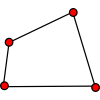
Flexi Quads

A quadrilateral changes shape with the edge lengths constant. Show the scalar product of the diagonals is constant. If the diagonals are perpendicular in one position are they always perpendicular?
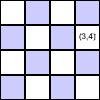
A Knight's Journey

This article looks at knight's moves on a chess board and introduces you to the idea of vectors and vector addition.
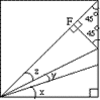
8 Methods for Three by One

This problem in geometry has been solved in no less than EIGHT ways by a pair of students. How would you solve it? How many of their solutions can you follow? How are they the same or different? Which do you like best?

  • Tech help
  • Accessibility Statement
  • Sign up to our newsletter
  • Twitter X logo

The NRICH Project aims to enrich the mathematical experiences of all learners. To support this aim, members of the NRICH team work in a wide range of capacities, including providing professional development for teachers wishing to embed rich mathematical tasks into everyday classroom practice.

NRICH is part of the family of activities in the Millennium Mathematics Project.

University of Cambridge logo NRICH logo