Skip over navigation
Cambridge University Faculty of Mathematics NRich logo
menu search
  • Teachers expand_more
    • Early years
    • Primary
    • Secondary
    • Post-16
    • Events
    • Professional development
  • Students expand_more
    • Primary
    • Secondary
    • Post-16
  • Parents expand_more
    • Early Years
    • Primary
    • Secondary
    • Post-16
  • Problem-Solving Schools
  • About NRICH expand_more
    • About us
    • Impact stories
    • Support us
    • Our funders
    • Contact us
  • search

Or search by topic

Number and algebra

  • The Number System and Place Value
  • Calculations and Numerical Methods
  • Fractions, Decimals, Percentages, Ratio and Proportion
  • Properties of Numbers
  • Patterns, Sequences and Structure
  • Algebraic expressions, equations and formulae
  • Coordinates, Functions and Graphs

Geometry and measure

  • Angles, Polygons, and Geometrical Proof
  • 3D Geometry, Shape and Space
  • Measuring and calculating with units
  • Transformations and constructions
  • Pythagoras and Trigonometry
  • Vectors and Matrices

Probability and statistics

  • Handling, Processing and Representing Data
  • Probability

Working mathematically

  • Thinking mathematically
  • Developing positive attitudes
  • Cross-curricular contexts

Advanced mathematics

  • Decision Mathematics and Combinatorics
  • Advanced Probability and Statistics
  • Mechanics
  • Calculus

For younger learners

  • Early Years Foundation Stage

How Much Can We Spend?

Age 11 to 14
Challenge Level Yellow star
Secondary curriculum
  • Problem
  • Getting Started
  • Student Solutions
  • Teachers' Resources

How Much Can We Spend? printable worksheet


A country has decided to have just two different coins.

It has been suggested that these should be 3z and 5z coins.
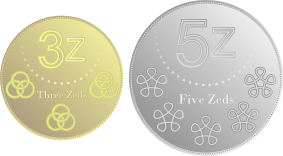
Proposed 3z and 5z coins

The shops think this is a good idea since most totals can be made.

 
$2\times3z+1\times 5z=11z$   $7 \times 3z + 2 \times 5z = 31z$


Unfortunately some totals can't be made, for example 4z.
Which totals can be made?

Is there a largest total that cannot be made?

How do you know?


They have decided that they will definitely have 3z coins but can't make up their minds about the other coin.

Experiment with other pairings containing 3z, and explore which totals can be made.
 

Can you find a relationship between 3z, the second coin, and the totals that can and can't be made?

In other countries they have also decided to have just two coins, but instead of the 3z coins they have chosen a different prime number.


Can you find a relationship between pairs of coin values and the totals that can and can't be made with them?


NOTES AND BACKGROUND

The coin problem (also referred to as Frobenius coin problem or Frobenius problem) is a mathematics problem associated with the German mathematician Ferdinand Georg Frobenius and often introduced in the context of making exact change given the availability of coins of specific denominations. To read about it go to Wikipedia.


You may also like

Have You Got It?

Can you explain the strategy for winning this game with any target?

Counting Factors

Is there an efficient way to work out how many factors a large number has?

Is There a Theorem?

Draw a square. A second square of the same size slides around the first always maintaining contact and keeping the same orientation. How far does the dot travel?

  • Tech help
  • Accessibility Statement
  • Sign up to our newsletter
  • Twitter X logo

The NRICH Project aims to enrich the mathematical experiences of all learners. To support this aim, members of the NRICH team work in a wide range of capacities, including providing professional development for teachers wishing to embed rich mathematical tasks into everyday classroom practice.

NRICH is part of the family of activities in the Millennium Mathematics Project.

University of Cambridge logo NRICH logo