Skip over navigation


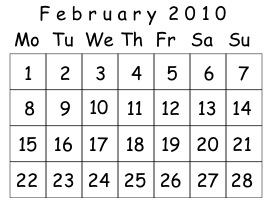
then there's my set of $28$ dominoes: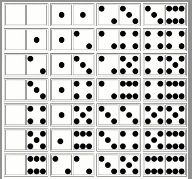
So, why don't you explore this number? Find $28$ flat shapes the same and put them together in some way.
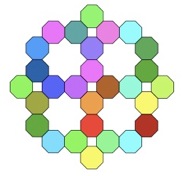
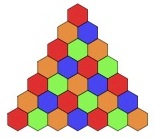
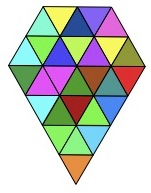
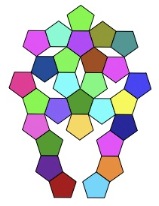
Here are some I found using circular discs, octagons, hexagons, triangles and pentagons.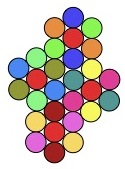
So It's 28
Age 5 to 7
Challenge Level 

So It's 28
I've just found that I keep coming across the number $28$.
Next Year's calendar for February:
then there's my set of $28$ dominoes:
So, why don't you explore this number? Find $28$ flat shapes the same and put them together in some way.
Here are some I found using circular discs, octagons, hexagons, triangles and pentagons.
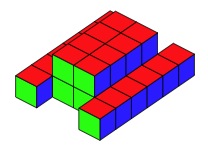
You may like to try $28$ cubes and get something like this:
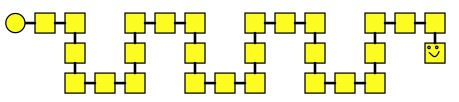
or put together to make a caterpillar with changes at the ends.
Let us know what you come up with and what you notice.
Why do this problem?
This activity is good for allowing pupils to explore both shapes and number, or to choose a particular aspect to focus on. There is a lot of freedom involved and there are exciting things to find out. Learners will be able to take control of their own learning and choose their own direction in this task.
Possible approach
You could begin by showing some of the pictures in the problem on the screen for the pupils to see and talk about. What similarities do they notice? What differences? They may pick up on the fact that the common link is the number $28$ straight away, but if not you can ask questions to probe them further. If some would like more examples they can be found here.
You can then set the group off on their own ideas using the number $28$. Pupils should be encouraged to ask themselves questions like " I wonder what would happen if I ...?", making a small change and exploring further.
Key questions
Tell me about what you've got here.
Is there anything special about this shape you have made?
Can you find another arrangement?
Possible extension
Talk about symmetry and look for final shapes that are symmetrical and those that are asymmetric.
Children who are used to investigating and have done well with this may like to move on to 28 - Upward and Onward.
Possible support
There may be a need for help with those with less developed fine motor skills for moving the shapes and fitting them together. Magnetic shapes can sometimes help.
You may also like
Homes
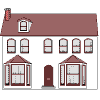
Six new homes are being built! They can be detached, semi-detached or terraced houses. How many different combinations of these can you find?
Number Squares
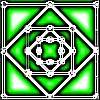
Start with four numbers at the corners of a square and put the total of two corners in the middle of that side. Keep going... Can you estimate what the size of the last four numbers will be?
Stairs
This challenge is to design different step arrangements, which must go along a distance of 6 on the steps and must end up at 6 high.