Skip over navigation


Here are the coordinates of nine points. It is possible to draw a triangle so that the shortest distance from each point to the triangle is at most one unit.
$(0, 0)$
$(8, 2)$
$(7, 8)$
$(170, 180)$
$(340, 360)$
$(2001, 1000)$
$(1500, 750)$
$(3000, 2000)$
$(4002, 2000)$
Can you find a suitable triangle? Is there more than one possibility?
Given three points, it is always possible to draw different triangles with edges passing through those three points - here are some examples of triangles going through the same three points:
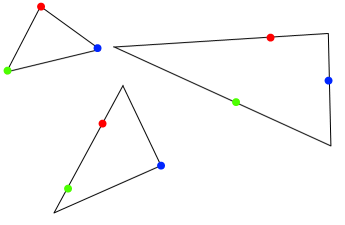 Can you convince yourself that there are always infinitely many such
triangles?
Can you convince yourself that there are always infinitely many such
triangles?
Here are some examples of different triangles going through the same set of four points:
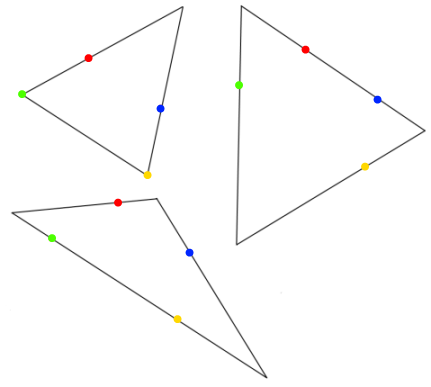
Is it always possible to draw triangles through a set of four points, whatever their position?
Investigate some examples and explain your findings.
What happens when we try to draw triangles through five points?
Close to Triangular
Age 14 to 16
Challenge Level 
Here are the coordinates of nine points. It is possible to draw a triangle so that the shortest distance from each point to the triangle is at most one unit.
$(0, 0)$
$(8, 2)$
$(7, 8)$
$(170, 180)$
$(340, 360)$
$(2001, 1000)$
$(1500, 750)$
$(3000, 2000)$
$(4002, 2000)$
Can you find a suitable triangle? Is there more than one possibility?
Given three points, it is always possible to draw different triangles with edges passing through those three points - here are some examples of triangles going through the same three points:
Here are some examples of different triangles going through the same set of four points:
Is it always possible to draw triangles through a set of four points, whatever their position?
Investigate some examples and explain your findings.
What happens when we try to draw triangles through five points?